
Lutron LED+ Pro Max Dimmer Load and Phase Guide
Match Diva, Maestro, or Sunnata Pro Max to LED, ELV, MLV, and incandescent loads, with phase, neutral, capacity, and flicker guidance.
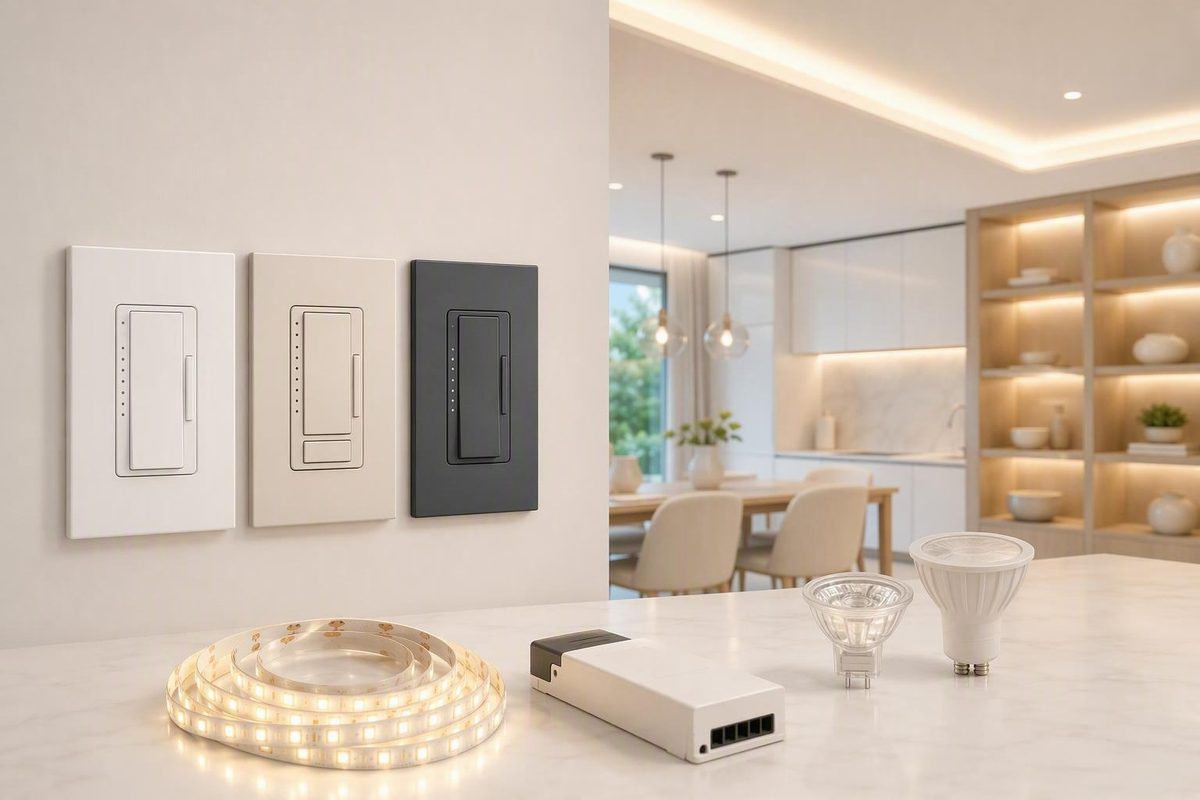
The Lutron LED+ Pro Max is a meaningful upgrade for troublesome LED, ELV, and MLV circuits, but it does not guarantee a flicker-free result. Its 250 W LED, 500 W ELV, 400 VA MLV, and 500 W incandescent/halogen ratings address loads the standard LED+ range did not cover as broadly, while auto-selectable forward or reverse phase and adjustable trim provide more ways to stabilize compatible equipment. It still cannot correct an overloaded circuit, a non-dimmable driver, the wrong control protocol, or an incompatible lamp.
Choose the circuit first and the interface second. Diva DV-PRO and Maestro MA-PRO generally work without a neutral on eligible LED and incandescent/halogen loads, but require one for ELV and MLV. Sunnata ST-PRO-N always requires a neutral. Lutron introduced the line with those three interfaces on July 8, 2026, according to CE Pro’s launch report.
Enter each fixture or driver, then select the wallbox and control details to test capacity, phase, neutral, and location limits.
Enter rated input watts for LED, ELV, and incandescent loads. For MLV, enter the transformer’s VA rating. Mixed load categories require exact-model review.
| Fixture/Circuit Item | Load Type | Count | W or VA Each | Total |
|---|---|---|---|---|
| — | ||||
| — | ||||
| — | ||||
| — | ||||
| — | ||||
| — |
Capacity By Category
LED 0 W of 250 W
ELV 0 W of 500 W
MLV 0 VA of 400 VA
Incandescent 0 W of 500 W
Calculated Setup
Eligible control: —
Starting phase: —
Neutral: —
Location check: —
Published Decision Data
| Load | Maximum | Phase Starting Point | Neutral Requirement |
|---|---|---|---|
| Dimmable LED | 250 W | Auto or equipment instructions | DV/MA generally no; ST always |
| Incandescent/halogen | 500 W | Forward | DV/MA generally no; ST always |
| ELV | 500 W | Generally reverse | Required on all three |
| MLV | 400 VA | Generally forward | Required on all three |
MA-PRO-WH has conflicting published LED and incandescent figures on Lutron’s webpage. Verify its current exact-model sheet before using a result near either limit. Minimum loads, mixed-load rules, ganging adjustments, and installation-specific derating are — in the supplied evidence.
The Verdict Depends On Load Type
Lutron documents the general maximum ratings for DV-PRO, MA-PRO, and ST-PRO-N as follows:
| Load | Maximum | Starting Phase | Neutral Rule |
|---|---|---|---|
| Dimmable LED | 250 W | Auto or specified | Model-dependent |
| Incandescent/halogen | 500 W | Forward | Model-dependent |
| ELV | 500 W | Usually reverse | Required |
| MLV | 400 VA | Usually forward | Required |
These are category limits, not compatibility guarantees. The controlled lamp, fixture, driver, or transformer must be dimmable, accept phase-cut control, and stay within the exact model’s applicable rating. Lutron publishes the ratings and neutral rules in its LED+ Pro Max model and load table.
Dimmable LED Loads Gain Better Commissioning, Not Universal Compatibility
The 250 W LED rating provides substantially more stated capacity than many older residential LED dimmers, but wattage alone does not predict behavior. Two collections of lamps carrying the same total wattage can have different inrush, startup, and low-level behavior.
Auto phase selection and manual phase control give the installer another variable to test. Low-end trim can keep the control above the point where lamps shimmer, drop out, or fail to restart. High-end trim can also limit the top of the range where needed.
Those adjustments help only when the LED electronics are compatible with phase-cut dimming. They cannot make a non-dimmable lamp work, and they do not guarantee that every load below 250 W will remain quiet and stable.
ELV Strip Drivers Receive The Clearest Upgrade
The Pro Max line carries a documented 500 W ELV rating. That makes it a direct candidate for a compatible phase-dimmable driver feeding low-voltage strip lighting.
The driver, not the LED tape, determines wall-dimmer compatibility. A 24 V LED tape system may use a phase-dimmable ELV driver, a 0–10 V driver, a low-voltage PWM controller, or a non-dimmable supply. Only equipment explicitly designed for line-voltage phase-cut dimming belongs on this control.
ELV equipment is generally associated with reverse-phase control, although the driver manufacturer’s instructions take priority. DV-PRO and MA-PRO require a neutral for ELV. ST-PRO-N already requires one for every load.
For a strip-light power supply, compare the driver’s input wattage—not merely the tape’s nominal wattage—with the 500 W limit. Check startup, full output, the entire dimming range, and restart behavior after setting the phase.
MLV Must Be Calculated In Volt-Amperes
The MLV limit is 400 VA, not 400 W. Size the circuit from the transformer’s documented volt-ampere load rather than adding only the lamp wattages connected to its secondary.
MLV transformers are generally associated with forward-phase control. The transformer instructions remain decisive, and it must be designed for dimming. All three Pro Max families require a neutral for MLV.
An MLV circuit below 400 VA can still buzz or dim poorly if the transformer is incompatible, the phase is wrong, or the low-end setting is unstable. Phase selection provides a troubleshooting option rather than a promise of silent operation.
Incandescent And Halogen Remain Straightforward
The generally published incandescent and halogen maximum is 500 W, with forward phase as the conventional starting point. DV-PRO and MA-PRO generally do not require a neutral for these loads; ST-PRO-N does.
The available evidence does not establish universal ganging adjustments, minimum loads, mixed-load rules, ambient-temperature limits, or installation-specific derating for every model. Consult the current technical document for the complete catalog number rather than treating 500 W as unconditional.
Auto-Select Does Not Replace The Equipment Instructions
LED+ Pro Max supports forward phase, reverse phase, and automatic phase selection. That flexibility is the principal reason it can solve more difficult circuits than a fixed-phase dimmer.
A practical starting point is forward phase for incandescent, halogen, and MLV; reverse phase for ELV; and the lamp or fixture manufacturer’s specified method for LED. A product described only as “LED” or “low voltage” does not reveal the correct phase.
Retail documentation for MA-PRO describes Auto-Select as choosing reverse phase when a neutral is connected and forward phase when it is not. Current Lutron instructions for the exact model should take priority over that shorthand. A neutral-connected circuit does not automatically mean every attached load should run in reverse phase.
Test manual phase selection when a compatible load flickers, buzzes, drops out, fails to start at a saved low level, or has an erratic dimming range. If one phase is worse, return to the manufacturer-specified or more stable setting. Neither mode can substitute for another protocol such as 0–10 V or low-voltage PWM control.
Low-End Trim Can Fix Dropout But Not Overload
Low-end trim raises the minimum commanded level. It is useful when lamps dim acceptably to a point and then shimmer, switch off, or fail to restart. Set the trim just above the lowest unstable level, then test startup from off several times.
Trim does not reduce the connected load for rating purposes. Six fixtures drawing 50 W each remain a 300 W LED load even if the high-end trim is lowered. That exceeds the documented 250 W LED maximum for one Pro Max dimmer.
An overloaded circuit should be divided, redesigned, or controlled with equipment carrying the required rating. Do not use phase selection or trim as a workaround for exceeding the applicable watt or VA limit.
Lutron promotes the line as addressing flicker, buzz, and hum, but the supplied evidence contains no independent comparative testing across every lamp, fixture, driver, and transformer combination. The defensible verdict is that Pro Max provides better commissioning tools; acceptable performance still has to be demonstrated on the installed circuit.
Neutral Requirements Eliminate Some Models Immediately
| Model | LED/Incandescent | ELV/MLV | Interface |
|---|---|---|---|
| DV-PRO | Generally no neutral | Neutral required | Paddle and slider |
| MA-PRO | Generally no neutral | Neutral required | Tap and raise/lower |
| ST-PRO-N | Neutral required | Neutral required | Touch light bar |
“Optional neutral” is therefore incomplete as a description of DV-PRO or MA-PRO. It applies only to eligible load categories. An ELV driver or MLV transformer requires the documented neutral connection with any of the three model families.
For an ELV installation, two separate conditions must be met: the dimmer must receive its required neutral, and the driver must support the selected phase-cut method. A neutral does not make a non-phase-dimmable supply compatible.
Neutral identification and line-voltage circuit alterations belong with a qualified electrician. Turn power off at the breaker or fuse before opening the wallbox, and use the exact model’s diagram rather than instructions for another Diva or Maestro product.
Diva, Maestro, And Sunnata Differ Mainly At The Wall
Once load, phase, neutral, and location count have been resolved, choose the interface.
Diva DV-PRO Provides A Familiar Slider
DV-PRO uses a conventional paddle with a separate level slider and locator light. It is the natural choice when occupants want to see the preset level without tapping buttons or using a touch bar.
Diva supports up to 10 total control locations. Lutron identifies the ST-AS accessory for documented multi-location switching and a traditional mechanical-switch option for a 3-way-only arrangement. Verify the exact wiring diagram before reusing existing switches.
Maestro MA-PRO Provides Deeper Programming
MA-PRO uses a tap switch with separate raise and lower controls. Its documented functions include preset level, delayed fade-to-off, low- and high-end trim, fade settings, indicator behavior, and manual or automatic phase selection.
It supports up to 10 total locations using the applicable MA-R or MSC-AD companions. Lutron’s MA-PRO selection guidance says the dimmer will not work properly with ordinary mechanical switches in the documented 3-way and multi-location arrangements.
Do not confuse MA-PRO with MACL-153M. They are different Maestro dimmers with different ratings and multi-location rules.
Sunnata ST-PRO-N Requires A Neutral Everywhere
ST-PRO-N uses a vertical touch light bar for on/off and level adjustment. It requires a neutral with LED, incandescent, halogen, ELV, and MLV loads.
Sunnata supports up to five total locations using ST-RD companions. Choose it when the touch interface is preferred, a neutral is present, and the circuit stays within that lower location limit.
The evidence does not establish app, hub, voice-assistant, or other smart-home connectivity for these models. Programming and touch controls should not be interpreted as connected-home features.
The MA-PRO Rating Conflict Requires Verification
Lutron’s MA-PRO-WH webpage contains inconsistent figures. Its overview reports 250 W LED and 500 W incandescent or halogen, while another electrical-specifications area reports 150 W LED and 600 W incandescent or halogen. Both areas report 400 VA MLV. The conflicting figures are visible on the MA-PRO-WH product page.
Do not choose whichever figure accommodates the planned circuit. Obtain the current specification sheet and installation guide for the exact catalog number and suffix. If the load approaches either published value, confirm the applicable rating with Lutron or the supplier before installation.
The conflict is especially relevant to the overload question. The calculator uses the line’s generally documented 250 W LED and 500 W incandescent ratings, but its result is not final authorization for MA-PRO-WH.
Commission The Complete Circuit Before Accepting It
After wiring has been checked against the exact instructions, start with the phase specified by the lamp, driver, or transformer manufacturer. If none is specified, use auto-select as an initial setting rather than proof of compatibility.
Turn the load on from off repeatedly and confirm that every fixture starts. Raise it to full output, lower it gradually, and watch for shimmer, abrupt steps, unequal lamp behavior, dropout, and delayed response. Listen near the dimmer, driver, transformer, and fixtures for objectionable noise.
Set low-end trim above the unstable point, then test another cold start at that saved level. Test every wall location, including presets, dimming, and fade behavior where applicable.
If problems remain, verify the load classification, total wattage or VA, required neutral, selected phase, companion family, and exact fixture compatibility. Instructions for another Maestro or Diva model should not be transferred because the controls look similar.
For multi-location work, count the primary dimmer as one location. Diva and Maestro allow up to 10 total locations; Sunnata allows up to five. Lutron’s Wiring Wizard can generate a model- and configuration-specific starting diagram.
Record the dimmer catalog number, controlled-equipment model, selected phase, minimum stable level, trim settings, companion models, and total location count. That record matters when a failed lamp, driver, or transformer is replaced later.
Warranty And Buying Checks
Lutron documents a 10-year warranty with product registration and a five-year warranty without registration. Retain proof of purchase and confirm the current registration conditions for the exact model.
The researched retailer snapshot listed white MA-PRO-WH at approximately $67.95, but it was undated and does not establish a current or line-wide price. Current pricing for the other models and finishes is not established by the supplied evidence.
Before ordering, verify the complete suffix, package contents, companion controls, wall plates, neutral availability, phase requirement, and current exact-model rating. The primary dimmer’s price does not include every accessory or any electrical work needed to correct the circuit.
The Pro Max is most likely to solve the original problem when the existing dimmer lacked the required load rating or phase option and the fixtures are otherwise phase-cut compatible. It is least likely to help when the driver uses another protocol, the circuit exceeds the applicable rating, or the lamps are inherently incompatible with wallbox phase dimming.