
Lumens vs Watts: Choose Brightness, Then Size the Load
Lumens measure light output; watts measure electrical power. Compare bulb replacements, calculate lm/W, and read LED strip and driver ratings correctly.
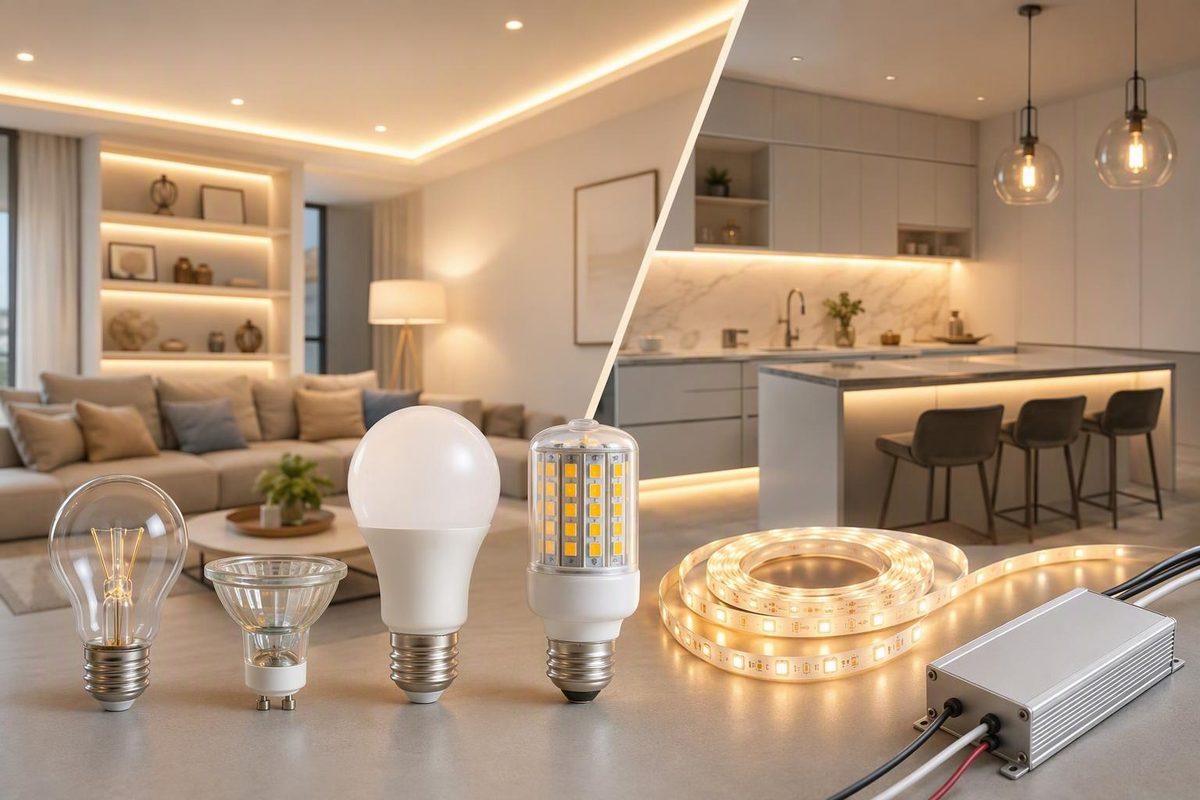
Lumens (lm) measure visible light output. Watts (W) measure electrical power. Choose lumens for the amount of light you want; use actual watts to compare power consumption and calculate an LED system’s load. A higher-wattage LED is not necessarily brighter than a lower-wattage one. The FTC’s bulb-shopping guide makes the distinction with an example: an LED can produce about 800 lumens using roughly 9 W, versus 60 W for a traditional incandescent bulb.
| Specification | What it tells you | Use it to… |
|---|---|---|
| Lumens (lm) | Total visible light emitted | Compare light output |
| Watts (W) | Electrical power used | Compare consumption and total the load |
| Lumens per watt (lm/W) | Light output per watt of power | Compare luminous efficacy |
| “60 W equivalent” | A brightness comparison with an old incandescent bulb | Identify a replacement—not its actual power draw |
Incandescent watts to lumens: replacement lookup
If you remember your old bulb’s wattage, use this table to choose a starting lumen target. These are ENERGY STAR’s replacement values for standard incandescent bulbs—not a universal watts-to-lumens conversion or a lookup for reflector lamps.
| Old incandescent bulb | Look for at least |
|---|---|
| 40 W | 450 lm |
| 60 W | 800 lm |
| 75 W | 1,100 lm |
| 100 W | 1,600 lm |
| 150 W | 2,600 lm |
For a familiar 60 W incandescent replacement, compare LEDs around 800 lm, then read their actual wattage. Do not treat “60 W equivalent” as a 60 W electrical load.
For reflector bulbs and spotlights, also match the beam pattern. Lumens tell you how much light leaves the source, not where it goes; a narrower beam can create a brighter patch while leaving surrounding areas darker. Waveform Lighting explains this distinction in its reflector-lamp guide.
Can you convert lumens to watts?
Only if you know the product’s luminous efficacy, measured in lm/W. The Department of Energy defines efficacy as light output per watt of power.
- Efficacy = lumens ÷ watts
- Watts = lumens ÷ efficacy
- Lumens = watts × efficacy
For a hypothetical comparison, an 800 lm bulb using 8 W has an efficacy of 100 lm/W. Another 800 lm bulb using 10 W has an efficacy of 80 lm/W. Both have the same rated light output; the first uses less power.
There is no single correct answer to “How many lumens is a 10 W LED?” Its output depends on its efficacy. Prefer the manufacturer’s published lumens and actual watts over a generic conversion chart.
For LED strips, keep the length units visible
Strip specifications commonly list lm/m or lm/ft for output and W/m or W/ft for load. Waveform Lighting’s strip guide explains why watts alone cannot establish brightness and gives the load formula: watts per unit length multiplied by installed length.
For a hypothetical 5 m strip rated at 1,000 lm/m and 10 W/m:
| Calculation | Result from strip ratings |
|---|---|
| 1,000 lm/m × 5 m | 5,000 lm total output |
| 10 W/m × 5 m | 50 W strip load |
| 5,000 lm ÷ 50 W | 100 lm/W strip efficacy |
These calculations use the strip’s ratings, not a measurement of the complete installed system. Compare strips using the same length units, and check whether an advertised lumen figure applies to one metre, one foot, or the whole reel. For multichannel strips, ask which operating mode the output and wattage figures describe.
Size the power supply from watts, not lumens. For constant-voltage tape, match the supply’s DC output voltage to the strip, then select sufficient output capacity under the manufacturer’s loading instructions. A supply’s wattage rating is its capacity, not a fixed amount it forces into the strip, as Waveform’s power-supply guide explains. Our 24 V power-supply guide covers the distinction between constant-voltage and constant-current drivers.
Check the rest of the specification before buying
Lumens and watts do not establish fit or control compatibility. Check the bulb base or strip voltage, dimensions, location rating, and supported dimming method. For an enclosed fixture, confirm that the bulb is approved for enclosed use; trapped heat can affect LED performance and life. The Department of Energy’s buyer tips cover enclosure and dimming checks.
Also compare color temperature in kelvin (K) and color rendering index (CRI): these describe light appearance and color rendering, not output. For a strip installation, use the strip, driver and dimmer compatibility guide before choosing the controls.