
Lumens vs Color Temperature: Output vs White-Light Tone
Lumens measure light output; kelvin describes warm or cool white. Learn how to compare both ratings on LED bulbs, fixtures and strips.
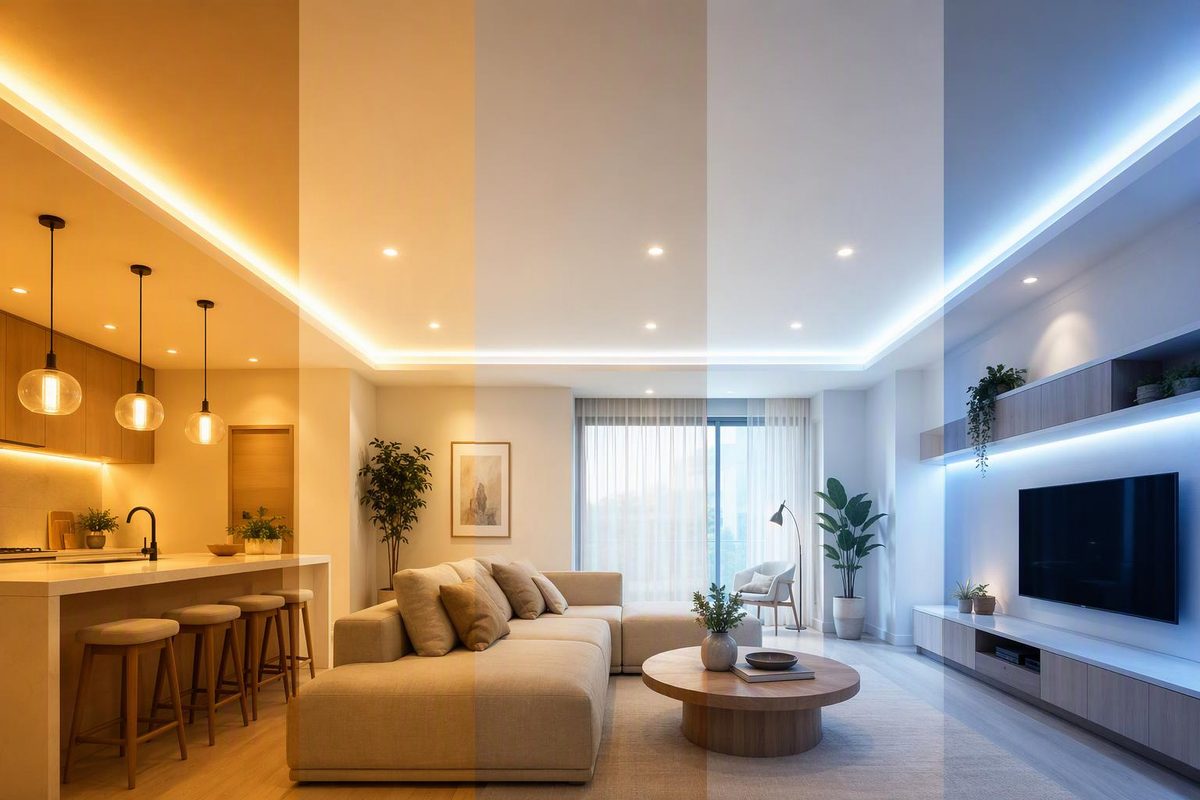
Lumens (lm) measure how much visible light a source emits. Color temperature, expressed in kelvin (K), describes whether its white light looks warm or cool. A higher lumen rating means more light output; a higher kelvin rating means a cooler white—not automatically a brighter light. These are separate specifications, not alternative ways to measure the same thing. See the FTC’s explanation of brightness and light appearance and Westinghouse’s kelvin guide.
| Specification | Lumens | Color temperature |
|---|---|---|
| Unit on the label | lm | K, often labeled CCT |
| Describes | Total visible light output | Warm-to-cool appearance of white light |
| Higher number means | More light emitted | Cooler, more blue-white light |
| Use it to answer | “Which product emits more light?” | “Does this white tone suit the space?” |
| Does not tell you | The white-light tone | How much light the product emits |
CCT means correlated color temperature. On an LED specification, it describes light appearance—not the operating temperature of the strip or fixture.
Does 5000 K mean brighter than 2700 K?
No. Consider two hypothetical bulb labels:
- 800 lm, 2700 K: 800 lumens of warm white light.
- 800 lm, 5000 K: the same rated light output, but a cooler, daylight-like white.
The second bulb has a different tone, not more rated output. Conversely, a 1600 lm bulb at 2700 K emits twice the rated lumens of an 800 lm bulb at 5000 K, despite being warmer.
As appearance reference points, 2700–3000 K is warm white, around 4000 K is a more neutral white, and 5000–6500 K is a cooler, daylight-like white. Product names such as “bright white” and “daylight” are descriptions of tone; use the numerical K value when comparing products. Westinghouse’s examples show these distinctions.
Equal lumens also do not guarantee equal lighting on a countertop: fixture placement and light distribution still matter. For that separate planning question, see how light output, room size and beam shape interact.
Read both ratings when choosing an LED strip
Compare output on the same length basis: lm/ft with lm/ft, or lm/m with lm/m. Then check the CCT of the exact version you intend to buy—not just the product family’s headline output.
Actual output can vary between CCT versions. For example, Diode LED’s BLAZE specification table lists its 24 V BLBSC3 strip at 344 lm/ft for 3000 K and 338 lm/ft for 5000 K. In that example, the cooler version does not emit more lumens. The lesson is to read the output table rather than infer brightness from kelvin. BLAZE specification sheet
For under-cabinet lighting, make two decisions: choose sufficient output for the work surface, then choose a white tone that looks right beside the room’s other lights. Preview a sample against the actual countertop and backsplash before committing to the full run.
Dimming and changing CCT are different controls
A static-white LED stays at essentially the same CCT as it dims. Tunable-white lighting lets you adjust white-light tone and intensity separately. Dim-to-warm lighting intentionally becomes warmer as output decreases. Those are different product capabilities; “dimmable” alone does not promise adjustable color temperature. Lutron’s guide to LED lighting types