
How Bright Is 2,000 Lumens? Rooms, Tasks and Beam Shape
At a 10-20 foot-candle planning range, that output theoretically corresponds to about 100-200 sq. ft. before fixture losses and uneven distribution.
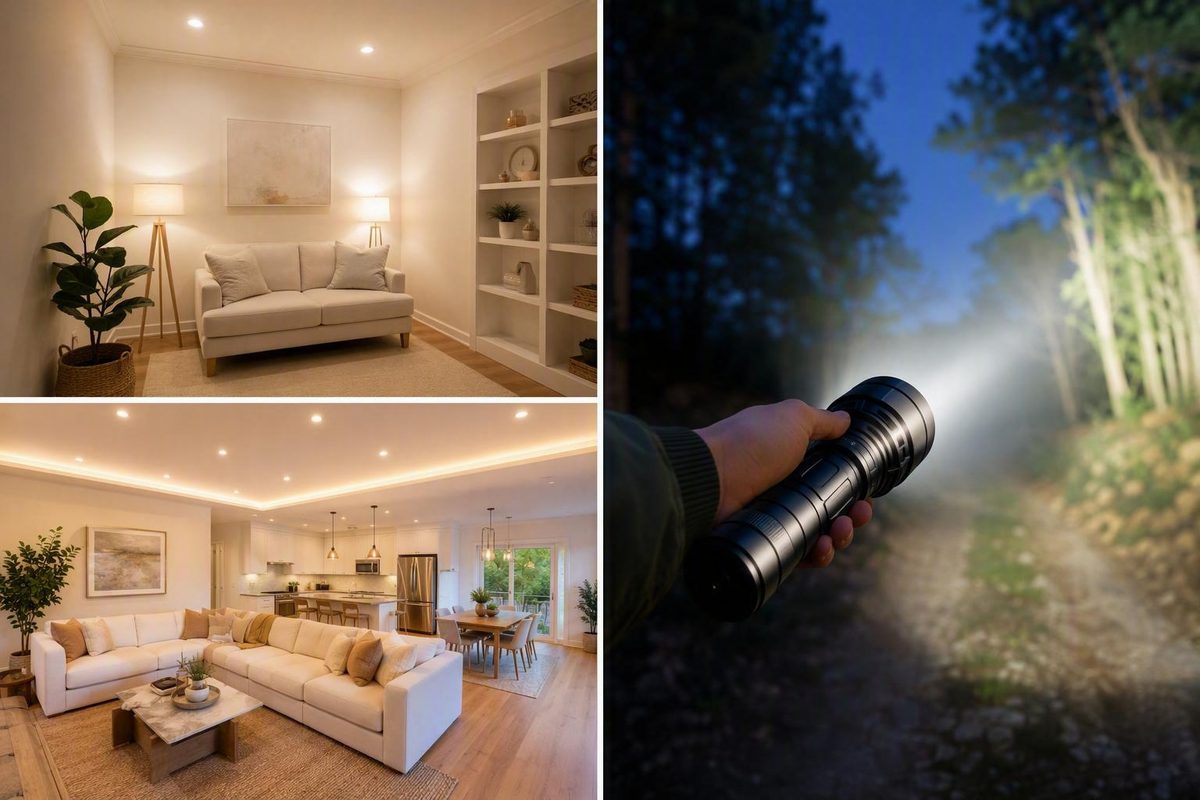
The short answer: 2,000 lumens is bright, but context decides whether it is enough
Two thousand lumens is bright in a small room, moderate ambient output in a medium-size room, and substantial output for a handheld flashlight. In a modest living room or bedroom, it can serve as the principal ambient light when the fixture distributes that output effectively.
As a familiar reference, 2,000 lumens is somewhat brighter than the output commonly associated with a traditional 100-watt incandescent bulb. It can make a compact room feel fully illuminated rather than merely accented, but it will not automatically cover every room or satisfy every task.
Where the light goes matters as much as the total output. A broad ceiling fixture can spread 2,000 lumens around a room. A pendant with an opaque shade may direct much of the same output onto a table. A narrow spotlight can create an intense patch while leaving nearby surfaces comparatively dark. All three can have the same lumen rating.
In a small bedroom, bedside application, decorative sconce, or intimate dining area, that output may feel harsh—especially if the source is visible or concentrated. Diffusion, multiple fixtures, and dimming can make it more comfortable.
Conversely, 2,000 total lumens may not provide enough useful illumination for detailed cooking, grooming, office work, repairs, or workshop activity. Those tasks depend on how much light reaches a counter, mirror, desk, or workbench—not simply how much leaves the fixture. A room can feel comfortably bright while its critical work surface remains shadowed.
The central limitation is simple: lumens describe total emitted light, not coverage, uniformity, glare, or illumination at a particular surface. Room dimensions, mounting height, fixture placement, beam shape, wall colors, and intended use determine what 2,000 lumens actually looks like.
Lumens, watts, lux, foot-candles, and candela are not interchangeable
Lighting specifications become easier to use once each measurement is assigned the right job.
A lumen measures luminous flux: the total quantity of visible light emitted by a source. A 2,000-lumen bulb, fixture, or flashlight therefore produces that total output, but the rating does not reveal whether the light forms a broad wash, a narrow beam, or an uneven pattern.
A watt measures electrical power consumption, not light output. Wattage once worked as a familiar brightness shortcut because conventional incandescent bulbs of similar construction produced broadly predictable output. LEDs, fluorescents, halogens, and incandescent lamps convert power into light at different efficiencies, so wattage is not a technology-independent brightness scale.
Lux and foot-candles measure illuminance—the light arriving at a surface. One foot-candle corresponds to one lumen incident on one square foot. These measurements are more useful than source lumens when the real question is whether a desk, countertop, floor, or wall receives enough light.
It is especially useful for flashlights, spotlights, and other directional sources. A high-candela light concentrates more intensity into its beam, while a lower-candela light may spread its output more broadly.
| Measurement | What it describes | When to use it |
|---|---|---|
| Lumens (lm) | Total visible-light output from a source | Comparing the overall output of bulbs, fixtures, and flashlights |
| Watts (W) | Electrical power consumed | Comparing energy demand, not brightness |
| Lux (lx) | Light arriving at a surface, measured per square meter | Evaluating illumination on floors, desks, counters, and other surfaces |
| Foot-candles (fc) | Light arriving at a surface, measured per square foot | Planning room and task illumination in imperial units |
| Candela (cd) | Luminous intensity in a particular direction | Comparing flashlight throw, spotlight intensity, and concentrated beams |
There is a useful—but deliberately simplified—planning relationship between lumens, area, and foot-candles. If every one of 2,000 emitted lumens reached a 100-square-foot receiving plane and was distributed perfectly evenly across it, the theoretical result would be 20 foot-candles. The underlying lumen method multiplies area by a target foot-candle level, but its results remain estimates rather than installed-light guarantees, as explained in Alcon Lighting’s lumen-method guide.
Real rooms do not meet that perfect condition. Shades absorb or redirect light, fixtures create brighter and darker zones, furniture casts shadows, and some output strikes walls or ceilings rather than the surface being evaluated. Dividing fixture lumens by floor area is therefore an initial planning calculation, not a prediction of measured illuminance.
How much area can 2,000 lumens cover?
There is no universal coverage area for 2,000 lumens. A useful first estimate is:
Room area in square feet × target foot-candles = estimated lumens required
Rearranging the calculation gives a theoretical lumen density for a fixed output:
2,000 lumens ÷ room area = theoretical lumens per square foot
| Room area | Theoretical average from 2,000 lumens |
|---|---|
| 50 sq. ft. | 40 lumens per sq. ft. |
| 100 sq. ft. | 20 lumens per sq. ft. |
| 150 sq. ft. | About 13.3 lumens per sq. ft. |
| 200 sq. ft. | 10 lumens per sq. ft. |
These figures are arithmetic results, not measured illuminance. They would correspond numerically to foot-candles only under the unrealistic assumption that all rated output reaches and is distributed evenly across the stated receiving plane.
At a theoretical target of 20 foot-candles, 2,000 lumens corresponds to 100 square feet before fixture losses and room conditions are considered. Spread over 200 square feet, the same output falls to a theoretical 10 lumens per square foot. Published residential planning guidance commonly places living rooms and bedrooms in a range of about 10–20 foot-candles, making 2,000 lumens a brighter baseline at the smaller end of that area range and a lower-end baseline at the larger end.
A statement such as “2,000 lumens covers 200 square feet” is therefore incomplete. It does not identify:
- The target light level
- The room’s purpose
- The mounting or ceiling height
- Fixture efficiency and distribution
- Wall and ceiling reflectance
- The height of the receiving surface
- Whether the goal is ambient or task lighting
Consider two rooms with the same area. One has a relatively low, pale ceiling, light-colored walls, and several well-positioned sources. The other has a high, dark ceiling, low-reflectance walls, and one shaded pendant. Both may contain fixtures rated for the same total output, yet the first will probably look brighter and more uniform.
Even in a simple rectangular room, installed illumination will not be perfectly even. Diffusers, shades, lenses, optics, fixture position, and furniture change where the output lands. Corners can remain dim while the area directly below a fixture is overlit. Use the calculation to screen options—not to replace measurements or a project-specific lighting assessment.
Is 2,000 lumens enough for each type of room?
Room recommendations are planning rules of thumb, not universal standards. The correct output depends on area, tasks, layout, finishes, occupants, desired atmosphere, and fixture distribution.
The following table assumes that 2,000 lumens is the total available output and distinguishes ambient illumination from more demanding task lighting.
| Room or area | How 2,000 lumens is likely to work | Main consideration |
|---|---|---|
| Living room | Potentially sufficient ambient light for roughly 100–200 sq. ft. | Brighter theoretical ambient light near 100 sq. ft.; lower-end ambient light near 200 sq. ft. |
| Bedroom | Often sufficient as general light in a modest room | May feel harsh in a small room unless diffused or dimmed |
| Dining area | May work over a compact table or within a layered plan | A 100-sq.-ft. area targeting 30–40 foot-candles would theoretically call for 3,000–4,000 lumens |
| General kitchen | Often needs supplementation or focused distribution | Counters and food-preparation zones benefit from dedicated task lighting |
| Bathroom | May provide ambient light but not necessarily effective mirror lighting | Grooming requires useful light at the face |
| Home office | Can make the room feel bright while leaving the desk underlit | Desk position, task lighting, and screen reflections matter |
| Hallway | May be more than necessary | Dimensions, fixture spacing, and desired atmosphere should control |
| Garage or workshop | Better treated as partial ambient output | Benches, tools, and repair areas need targeted task lighting |
The area ranges and dining or kitchen calculations apply commonly published targets of approximately 10–20 foot-candles for living rooms and bedrooms, 30–40 for dining rooms and general kitchens, and 5–10 for hallways. These are planning assumptions rather than guaranteed installed levels; the method and ranges are summarized in Alcon Lighting’s residential lumen guidance.
Living rooms: In a compact living room, this output can provide relatively bright ambient light. As the room becomes larger, it becomes a softer baseline. A reading chair may still need a nearby lamp because a comfortable room average does not guarantee adequate light on a book.
Bedrooms: Two thousand lumens can be enough for dressing, making the bed, and cleaning a modest room. It may be unpleasant at full output before sleep, particularly from an exposed central source. Dimming and bedside lights allow the room to support both practical and restful use.
Dining areas: The answer depends on whether the fixture lights only the tabletop or the entire room. A pendant that directs most of its output toward a compact table can make that surface look bright while leaving the perimeter comparatively dark. A diffuse fixture may create a softer room-wide effect but deliver less concentrated light to the table.
Kitchens: General brightness is not the same as adequate counter illumination. A person standing between a central ceiling fixture and the countertop can cast a shadow over the work area. Well-positioned task lighting may be more effective than adding all output to one central fixture.
Bathrooms: A bright ceiling light can make a small bathroom feel well illuminated, but downlight alone may produce facial shadows. Grooming quality depends on fixture position and whether useful light reaches the face.
Home offices: A comfortable ambient level does not guarantee good visibility on paper or a keyboard. Task lighting should support the desk without producing distracting monitor reflections.
Hallways: Circulation spaces generally have lower visual demands than work areas. In a short or narrow hallway, the full output may be unnecessarily intense. Several lower-output fixtures can sometimes provide better spacing and fewer dark gaps.
Garages and workshops: Two thousand lumens can contribute useful general light, but it is not automatically sufficient for vehicle work, bench work, painting, measuring, or inspecting small parts. Those activities benefit from dedicated task fixtures positioned to reduce shadows.
The key distinction is between ambient lighting, which supports navigation and establishes the room’s overall appearance, and task lighting, which serves a specific activity. Do not mistake a comfortable room average for adequate illumination on a counter, mirror, desk, or bench.
Why two 2,000-lumen lights can look completely different
The lumen rating tells you how much light is produced in total. It does not tell you where that light will go.
Beam spread is one of the largest variables. Concentrating the output into a narrow area creates a brighter hotspot. Spreading it across the walls, ceiling, and floor produces broader but less intense coverage. Neither pattern is inherently better; the correct distribution depends on the application.
One concentrated ceiling fixture may create strong illumination in the center of a room and deep shadows at the edges. Several fixtures with the same combined lumen output can distribute the light more evenly and reduce hard shadows, although poor placement can still cause glare.
Mounting height changes both distance and coverage. As the source moves farther from the work plane, the beam generally covers a larger area and delivers less useful illumination to any one point. Beam pattern and fixture spacing consequently become more important in taller spaces.
Surface reflectance also changes the result. White or light-colored, high-reflectance surfaces return more light to the room, while dark or otherwise low-reflectance surfaces return less. There is no single correction multiplier suitable for every room.
Shades, diffusers, and lenses can conceal intense LEDs, soften hotspots, and improve visual comfort. They can also absorb or redirect some output. An opaque shade may send light primarily downward, a translucent shade can glow in several directions, and a clear lens may preserve intensity while exposing more glare.
Fixture geometry and aiming determine whether the light reaches the useful surface. A recessed downlight, wall washer, pendant, and adjustable spotlight can carry the same lumen rating while producing very different patterns.
Natural light changes the daytime impression without changing the fixture’s output. A ceiling light may seem modest in a sunlit room and strikingly bright after dark.
Color temperature influences atmosphere: warmer light can feel relaxed and intimate, while cooler light may appear crisper. Neither characteristic changes the lumen total, but both can influence perceived quality and visual clarity.
Finally, twice the lumens should not be interpreted as automatically looking twice as bright. Human visual adaptation, surrounding brightness, glare, contrast, and beam distribution all affect perception. Lumens are useful for comparing total output, not for predicting a linear subjective response.
How 2,000 lumens compares with incandescent and LED wattage
There is no exact, technology-independent conversion from lumens to watts. Lumens measure light output; watts measure electrical input. The relationship depends on efficacy—lumens produced per watt—as well as driver losses, fixture design, operating conditions, and how the product was tested.
A commonly cited 100-watt incandescent reference produces approximately 1,500–1,700 lumens. Against that range, 2,000 lumens provides approximately:
- 33% more output than 1,500 lumens
- 25% more output than 1,600 lumens
- 18% more output than 1,700 lumens
Those reference outputs and the distinction between lumens and watts are described in The Home Depot’s guide to estimating room lumens.
A useful arithmetic correction follows: 2,000 lumens is 125% of 1,600 lumens, which means 25% more output—not 125% more.
Rather than declaring one exact incandescent equivalent, it is more accurate to place 2,000 lumens between common 100-watt and 150-watt references. One comparison table lists about 1,600 lumens for a 100-watt incandescent and about 2,600 lumens for a 150-watt incandescent, placing 2,000 between them in the retailer’s room-lighting guide.
For LEDs, approximately 18–30 watts is a broad range found in the supplied commercial guidance for products producing around 2,000 lumens. It is not a specification for every LED: products differ in efficacy, drivers, optics, thermal design, and whether the rating applies to a bare lamp or complete fixture. The variation across that range is illustrated in this manufacturer’s 2,000-lumen comparison.
When buying, use the actual product label or specification:
- Check the lumen rating for total output.
- Check the watt rating for power consumption.
- Confirm whether the lumen rating applies to the complete fixture.
- Review beam angle or distribution information.
- Treat an “incandescent equivalent” label as a familiarity aid, not the primary specification.
Two LED products can have the same nominal lumen output while consuming different wattages and producing very different beam patterns.
When 2,000 lumens is too bright—and how to make it comfortable
Two thousand lumens can be excessive in a small bedroom, at a bedside, over an intimate dining table, in a decorative sconce, or in another relaxation-oriented setting. The problem is often not total output alone. Discomfort can come from a visible high-intensity source, concentrated hotspot, poor placement, or strong contrast between the fixture and its surroundings.
A bare source can feel glaring even at a lower total output. Conversely, a diffused fixture spreading the same output across a larger room may feel comfortable. Before rejecting the lumen rating, consider how the light is delivered.
Dimming is useful when one room serves several purposes. Full output may be valuable for cleaning, organizing, or detailed activity, while a lower setting may suit dining, watching television, or preparing for sleep.
Check that the lamp or fixture is designated as dimmable and that the dimmer is compatible with the relevant driver and load.
Diffusion can soften intense points and reduce abrupt transitions between bright and dark areas. Frosted lenses, shades, indirect reflection, and suitable diffuser profiles can improve comfort, although each design changes distribution and may reduce the amount of light delivered in a particular direction.
Distributing the output can also help. Instead of concentrating everything in one exposed central fixture, several sources can provide a similar combined output with better uniformity and fewer hard shadows.
A layered plan divides lighting into three roles:
- Ambient light provides general visibility and supports navigation.
- Task light serves reading, cooking, grooming, desk work, or repairs.
- Accent light emphasizes artwork, architecture, or visual features.
Layering avoids asking one bright fixture to perform every role. It also allows the ambient level to remain comfortable while task fixtures provide stronger illumination only where needed.
For mains-powered fixtures and controls, follow the equipment instructions and requirements that apply where you live. If the work is outside your experience or permissions, use qualified help rather than treating general lighting guidance as wiring instruction.
How bright is a 2,000-lumen flashlight or outdoor beam?
For a handheld flashlight, 2,000 lumens is substantial output. It can produce a powerful near-field flood, an intense throw beam, or a combination of hotspot and spill. The lumen rating alone does not reveal which.
Flashlight performance involves several separate specifications:
- Lumens: Total emitted output
- Candela: Peak directional intensity
- Beam angle or profile: How narrowly or broadly the output is distributed
- Measured beam distance: A product-specific result derived under stated test conditions
- Sustained output: The output maintained after the initial maximum mode
A lower-lumen flashlight with a narrow reflector or specialized optic can illuminate a distant target better than a wider 2,000-lumen floodlight. The floodlight distributes more output across the foreground and sides, while a throw-oriented light concentrates intensity into a smaller distant area. A specialist flashlight guide demonstrates why more lumens do not necessarily mean greater beam distance.
For long-range use, candela and beam data are therefore more informative than lumens alone. For walking, close-range searches, campsite illumination, or broad outdoor visibility, a flood beam may be more useful even if it has less throw.
More foreground light is not always beneficial. A dimmer distant target may then become harder to distinguish. A narrower beam can improve long-range visibility by limiting unnecessary spill.
Comparison photographs can illustrate whether a beam is floody or throwy, but they cannot reproduce exactly what every viewer will see. Camera exposure, sensor response, lens settings, image processing, display brightness, optics, atmosphere, and viewing conditions all affect the result.
When comparing flashlights or outdoor spotlights, check more than the advertised peak:
- Review candela or beam-intensity information.
- Look at the stated beam profile and angle.
- Check product-specific beam-distance data.
- Distinguish peak output from sustained output.
- Decide whether the intended use favors nearby coverage or distant identification.
“Two thousand lumens” tells you the total output. It does not, by itself, tell you how far the flashlight will shine.
A practical checklist for deciding whether 2,000 lumens is right
Start with the job rather than the lumen number. The same output can be appropriate for one application and frustrating in another.
1. Define the purpose
Decide whether the light is intended for:
- General ambient illumination
- Reading
- Cooking
- Grooming
- Desk or craft work
- Garage or workshop activity
- Outdoor area lighting
- Long-range visibility
A fixture selected for soft ambient lighting should not be judged by the same criteria as a workbench light or throw-oriented flashlight.
2. Calculate the room area
Multiply length by width to find the square footage. Divide the fixture’s output by that area to obtain a theoretical lumen density. Remember that the result does not become measured foot-candles unless all output reaches and is distributed evenly across the receiving plane.
3. Separate ambient and task requirements
Ask where the light must actually land. If the room contains a countertop, mirror, desk, reading chair, or workbench, plan that surface independently. A central fixture may provide adequate ambient light while leaving the task zone in shadow.
4. Examine fixture distribution
Check whether the fixture is:
- Broad and diffuse
- Narrow and directional
- Primarily downlighting
- Indirect or uplighting
- Enclosed by an opaque or translucent shade
- Adjustable or fixed
If product documentation includes a beam angle or photometric distribution, it will usually tell you more about coverage than the lumen number alone.
5. Assess room conditions
Consider:
- Ceiling or mounting height
- Wall and ceiling reflectance
- Matte or glossy finishes
- Furniture and partitions
- Natural light
- Fixture placement
- Shadows created by occupants
- The height of desks, counters, and other work surfaces
High mounting positions and dark, low-reflectance surfaces generally leave less useful light at the target surface than lower mounting positions and pale, reflective surroundings.
6. Decide whether one source or several is better
One concentrated fixture can work when the goal is to emphasize a table or zone. Several distributed sources are often more effective when even room-wide coverage is the priority.
7. Consider dimming
A dimmable option is valuable when the same room supports both demanding activity and relaxation. Confirm that the lamp, fixture, driver, and control are intended to work together.
8. Use the right secondary specification
For room lights, prioritize delivered illumination, beam spread, mounting position, and distribution. For flashlights and spotlights, examine candela and beam information alongside lumens.
The decision summary is straightforward: 2,000 lumens is a sensible ambient-light starting point for many modest rooms, potentially excessive in small intimate settings, and not automatically enough for detailed tasks or large spaces.
Frequently asked questions
Is 2,000 lumens enough to light an entire room?
It can be. In a modest living room or bedroom, that output may provide the main ambient light. Under a commonly published planning range of 10–20 foot-candles, it corresponds theoretically to about 100–200 square feet—but only before fixture losses, uneven distribution, and room conditions are considered. Comparable room ranges and assumptions are outlined in this room-by-room lumen guide.
A high ceiling, dark surfaces, restrictive shade, narrow beam, or poor placement can make the room look dimmer. Kitchens, offices, garages, and other task-oriented rooms may also need dedicated lighting at counters, desks, or benches.
Is 2,000 lumens too bright for a bedroom?
It may be too bright for a small bedroom at full output, especially when the fixture is exposed, concentrated, or close to eye level. In a larger bedroom with diffuse distribution, it may provide useful general illumination.
A dimmable fixture is often the most flexible choice. Full output can serve cleaning and dressing, while a lower setting or separate bedside lights can create a more restful atmosphere.
How many LED watts are needed to produce 2,000 lumens?
A broad commercial estimate is approximately 18–30 LED watts, but there is no fixed conversion. LED efficacy, driver losses, fixture design, operating conditions, and testing methods vary; the range itself varies across published product guidance, including this LED lumen-to-watt comparison.
Use the product’s actual lumen and watt ratings rather than assuming every fixture with this output consumes the same power. Also confirm whether the published output refers to the LED components or the complete fixture.
How does 2,000 lumens compare with a 100-watt incandescent bulb?
A traditional 100-watt incandescent is commonly referenced at approximately 1,500–1,700 lumens. Two thousand lumens therefore represents roughly 18–33% more total output than that range, according to the comparison figures in The Home Depot’s lumen-estimation guide.
Using a 1,600-lumen reference, 2,000 lumens is 125% as much output—or 25% more, not 125% more. It is best described as falling between common 100-watt and 150-watt incandescent output references rather than as one exact equivalent.
How far will a 2,000-lumen flashlight shine?
The lumen rating alone cannot answer that. Beam distance depends strongly on candela, reflector or lens design, beam angle, and how much output is concentrated into the hotspot.
A narrow lower-lumen flashlight can reach farther than a broad 2,000-lumen floodlight. Check the product’s candela, measured beam-distance information, beam profile, and sustained output rather than judging throw from peak lumens alone; the distinction is explained in this flashlight brightness and beam-distance guide.
Ultimately, 2,000 lumens is a meaningful amount of light, not a complete lighting specification. Judge room lighting by area, intended activity, distribution, mounting height, surfaces, and dimming needs. For a flashlight, pair lumens with candela, beam profile, distance data, and sustained output.