
Square Can Lights: Cutouts, Lumens and Ratings
Compare square can lights by cutout shape, lumens, clearance, glare control, location rating and dimmer support before cutting the ceiling.
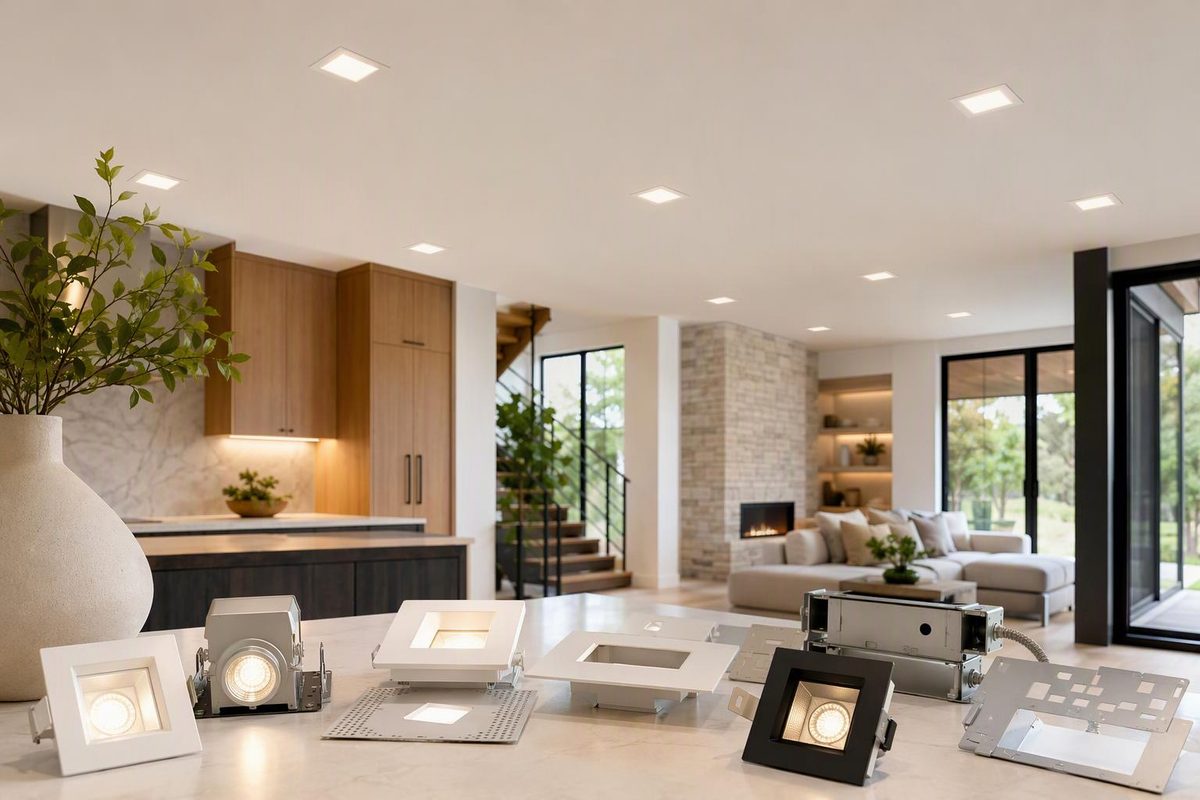
A “square can light” may be a square-trim retrofit module, a canless light requiring a square ceiling opening, or a square-faced light made for a round opening. Identify the installation type and exact cutout before comparing nominal 4-inch or 6-inch sizes. Leviton’s 4-inch square DBS40 requires a 4-1/4-inch square cutout, while Halo’s HLB4SP has a square face but uses a 4.18-inch round cutout. They are not interchangeable simply because both are sold as 4-inch square downlights (Leviton product bulletin; Halo HLB4SP specification).
Select your ceiling opening and minimum output; the documented candidates update below.
Documented Square-Light Fit Checker
| Model | Opening | Output | Plenum |
|---|---|---|---|
Leviton DBS40Fit notes4-inch square baffle model; rated at 12 W. Confirm the supplied template and ceiling-thickness range. | 4¼ in square | 850 lm | — |
Halo HLB4SPFit notesSquare-faced canless light made for a round opening. Published output was not provided in the article evidence. | 4.18 in round | — | — |
Juno WF4 squareFit notesSelects 450, 550 or 750 lumens. Use the exact square template; the cutout dimension is not stated in the article evidence. | Template required | 450–750 lm | 3 in |
Juno WF6 squareFit notesSelects 650, 850 or 1,000 lumens. Use the exact square template; the cutout dimension is not stated in the article evidence. | Template required | 650–1,000 lm | 2 in |
No listed reference model has documented compatibility with this combination. Check the exact housing, opening and manufacturer template rather than enlarging the hole by assumption.
Sources: Leviton DBS series, Halo HLB4SP and Juno square Wafer specification. A dash means the cited evidence here does not provide the value.
Match the Light to the Ceiling Condition
| Ceiling condition | Product to look for | What must match |
|---|---|---|
| Existing recessed housing | Listed LED retrofit module with square trim | Housing dimensions, mounting method, connector and approved compatibility |
| Finished ceiling without a housing | Canless or direct-mount square downlight | Exact cutout, ceiling thickness, driver clearance and cable access |
| New ceiling before drywall | Canless light with its specified plate, or a housing-and-trim system | Framing, mounting hardware, cutout and service access |
| Existing round opening | Square-faced model specifically made for a round opening | Opening diameter and trim overlap |
“Retrofit” does not always mean a consumer lamp that screws into a residential can. Square retrofit and remodel products include commercial-style modules with their own installation requirements, such as Lithonia’s LBR4 Square series. Check the approved application and compatible components for the exact catalog number (Lithonia LBR4 Square product page).
“Canless” does not mean the complete fixture is only the thin panel visible from below. It normally includes a remote driver and junction box above the ceiling. Juno’s square Wafer needs no traditional recessed housing, but its fixture and driver box both occupy ceiling space (Juno Square Wafer product page).
Never cut the ceiling from the advertised nominal size. Obtain the installation template or dimensional drawing for the exact catalog number. If an opening already exists, verify both that the fixture fits it and that the trim completely covers it without an improvised patch.
Choose 4-Inch or 6-Inch by Output
Nominal size does not reliably predict brightness. Within Leviton’s square baffle series, the 4-inch model is rated at 850 lumens and 12 W, while the 6-inch model is rated at 1,100 lumens and 15 W.
Juno’s current square Wafer models have three selectable outputs. The 4-inch model provides 450, 550 or 750 lumens; the 6-inch model provides 650, 850 or 1,000 lumens (Juno square Wafer specification). A 6-inch label therefore does not guarantee more output than every 4-inch fixture.
Select quantity and output together. Estimate the room’s required light, subtract useful output from pendants, lamps and task fixtures, and divide the remaining target by the downlight’s delivered lumens. Then refine the layout for ceiling height, beam spread, walls and work surfaces. Our recessed-light quantity guide provides a starting calculation and explains why floor area alone is insufficient.
Selectable output is useful when the final level is uncertain. Before closing out the installation, set every fixture in the same visual group to matching lumen and correlated color temperature settings.
Flat and Regressed Lights Control Glare Differently
A flat wafer spreads light from a broad luminous surface and requires little fixture depth. Its lens remains visible from wide viewing angles, including from across a room or while someone is reclining.
A regressed lens places the source higher behind a baffle or reflector. This can improve visual comfort and produces a more conventional downlight appearance, but it requires additional fixture depth. Leviton says its regressed baffle reduces glare, while Juno’s wider Wafer family includes flat, regressed and deep-regressed styles (Juno Wafer family).
Use a flat model when clearance is the controlling constraint. Consider a regressed model when occupants will frequently see the ceiling from shallow angles. Confirm that the stated style and dimensions apply to the square catalog number being purchased; options shown for a wider product family may apply only to its round fixtures.
Ratings Must Match the Installation
A suitable square recessed light should document every condition that applies:
- IC rating: Verify it when the fixture or driver will contact insulation. Do not infer an IC rating from a low-profile shape.
- Airtight construction: This matters where the ceiling forms part of the building’s air barrier and is separate from the IC designation.
- Wet or damp location: Match the listing to the actual exposure. A wet-location listing may be limited to covered ceilings.
- Ceiling type and thickness: Spring clips have a defined clamping range.
- Voltage: Many residential canless models use 120 V, but the exact product label controls.
- Dimming method: Verify the fixture, driver and dimmer as a combination.
Juno’s square Wafer specification lists 120 V triac dimming from 100% to 10%. Halo’s HLB4SP documentation identifies compatible leading- and trailing-edge phase-cut dimming down to 5%. Those figures apply to the named product families, not to square lights generally.
Check the manufacturer’s approved-dimmer list instead of assuming every LED dimmer will reach the advertised low end without flicker or buzz. Lutron also maintains a searchable LED compatibility tool.
Check Driver Clearance Before Cutting
A slim panel may fit below a joist while its driver box does not. The supplied connecting lead must also reach the box; use only extension cables approved for that fixture.
In Juno’s current square Wafer specification, the 4-inch driver box requires 3 inches of plenum space, while the 6-inch driver box requires 2 inches. These are model-specific requirements, not general rules for 4-inch and 6-inch canless lights.
Locate framing, ducts, pipes and other obstructions before marking final centers. Square trims make rotational errors conspicuous, so establish one reference line from a long wall or cabinet run and orient every opening to it.
Before buying a roomful, inspect one sample and its documentation. Confirm the cutout shape and dimensions, trim coverage, ceiling depth, lumen setting, CCT, CRI, location listing and approved dimmers. The remote driver and junction box connect to household line voltage, so their circuit wiring falls under the applicable electrical rules and licensing requirements rather than low-voltage LED practices.