
LED Driver Wattage Requirements: Headroom and Usable Output
Calculate LED driver wattage, compare 20% headroom with 80% loading, and check usable output against temperature and compatibility limits.
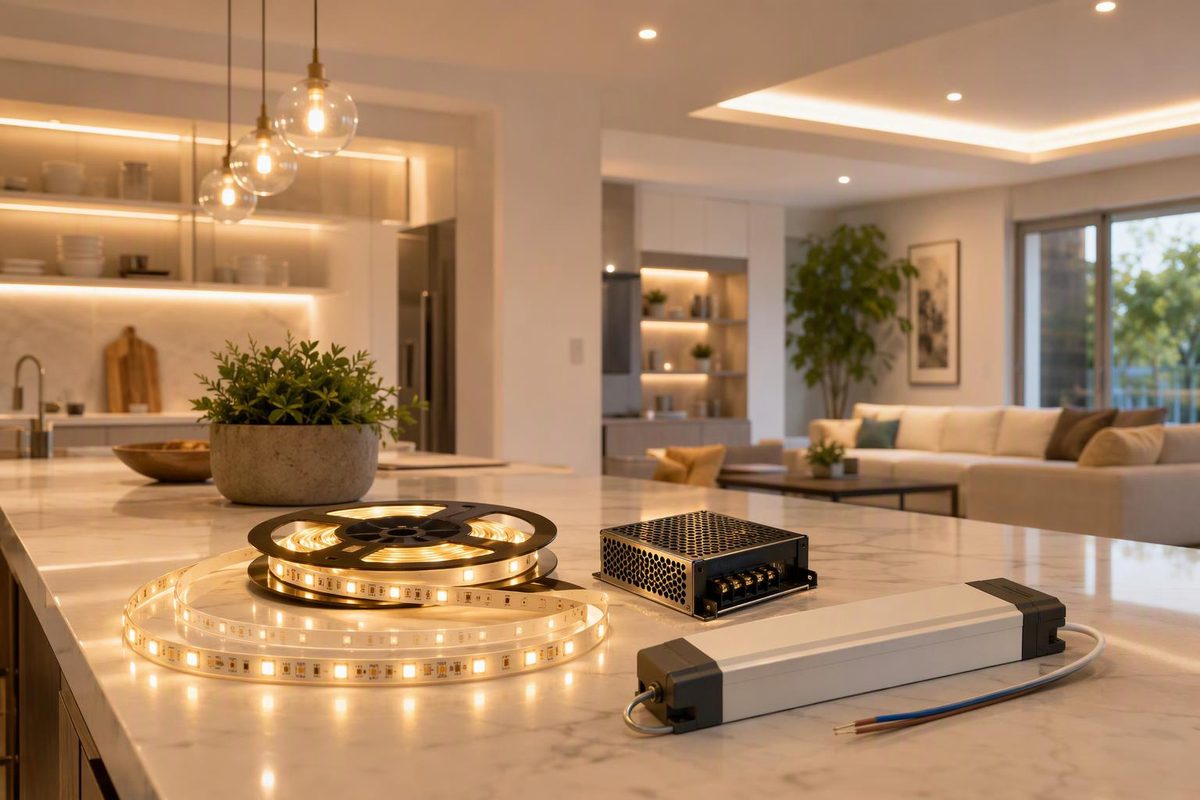
For a constant-voltage LED strip, multiply its maximum watts per metre or foot by the installed length, add every other load on the same supply, and choose a driver with matching output voltage and sufficient usable output watts. Apply any manufacturer-required allowance; if you add planning headroom, state which calculation you are using.
For example, 5 m × 14.4 W/m = 72 W. Adding 20% gives 86.4 W of required capacity. Keeping the load at no more than 80% of capacity gives 90 W. A compatible 100 W driver is a candidate under either method—not a final selection until its operating conditions and controls also match.
Identify the driver type first
| LED product specification | Required driver | What must match |
|---|---|---|
| Fixed voltage, such as 12 V DC or 24 V DC | Constant voltage (CV) | Output voltage; sufficient output watts and amps |
| Specified drive current, such as 700 mA, with an operating voltage range | Constant current (CC) | Output current; voltage operating range; sufficient power |
Conventional resistor-equipped LED tape generally needs constant-voltage power. Bare LED strings and some fixture modules need constant-current regulation. MEAN WELL’s application guidance distinguishes these circuits and requires a constant-current load to fall within the driver’s constant-current operating region.
Do not choose a replacement fixture driver by wattage alone. A higher-power CC driver with the wrong current is not a suitable upgrade. Follow the fixture or module specification. See constant voltage versus constant current for the distinction.
Calculate the connected load before adding headroom
For constant-voltage strips:
Strip load (W) = installed length × rated W per unit length
Total load (W) = all strip loads + other loads powered by that driver
Use the specification for the exact strip and keep units consistent: W/m must be multiplied by metres, not feet. Waveform Lighting’s sizing guide uses this calculation and the DC relationship W = V × A.
Calculate for the maximum permitted load that can operate simultaneously, not your usual dimmed setting. Include a controller’s own consumption if its documentation specifies that it draws from the same supply; do not count the strip load twice merely because it passes through that controller.
Compare the load with the driver’s DC output rating, not its AC input current or wall-power consumption. For the complete 12 V selection process, including output-current calculations and supply formats, use our 12 V LED power-supply guide.
Adding 20% is not the same as loading to 80%
| Calculated load | Add 20%: load × 1.20 | Limit loading to 80%: load ÷ 0.80 |
|---|---|---|
| 24 W | 28.8 W | 30 W |
| 48 W | 57.6 W | 60 W |
| 72 W | 86.4 W | 90 W |
| 96 W | 115.2 W | 120 W |
| 120 W | 144 W | 150 W |
Waveform Lighting’s calculator recommends a 20% allowance above strip power. Keeping a load at 80% of capacity instead means choosing 25% more capacity than the load. Round up to an available compatible model after applying the applicable allowance.
Treat these percentages as planning methods, not substitutes for the selected product’s instructions or mains-circuit sizing rules. MEAN WELL says its LED drivers can operate continuously at full load when their specified working-temperature and case-temperature limits are met. An 80% output-loading target is therefore not a requirement imposed by every driver manufacturer.
Check usable output, not just the label
Headroom does not replace the datasheet’s derating curve. MEAN WELL’s installation manual warns that high ambient temperatures or nonstandard mounting orientations may require output-current derating. It also requires ventilation and prohibits exceeding rated output current or wattage.
If a nominal 100 W driver is limited to 70 W under the intended conditions, it cannot supply the example’s 72 W load. To preserve an 80% loading target, that load would need at least 90 W of usable capacity under those conditions.
A larger compatible CV supply provides more available capacity; it does not force its full rated wattage into the strip. Waveform Lighting explains that the connected load determines the power drawn. Still check any documented minimum load and dimming limits. Use the strip, driver and dimmer matching guide to settle control compatibility.
More driver watts also do not remove cable resistance or strip run limits. MEAN WELL’s guidance warns that extending DC cables can cause voltage drop. Plan conductor size and feed locations separately; do not raise voltage beyond the strip’s specification to compensate.
Keep mains terminations and circuit changes with a qualified electrician working to local requirements. Disconnect power before installation or maintenance and follow the driver’s installation instructions.