
SOB LED Strip vs COB: What Actually Changes?
Compare SOB and COB LED strips by construction, visible finish, rated output, run limits and installation fit—not category-wide promises.
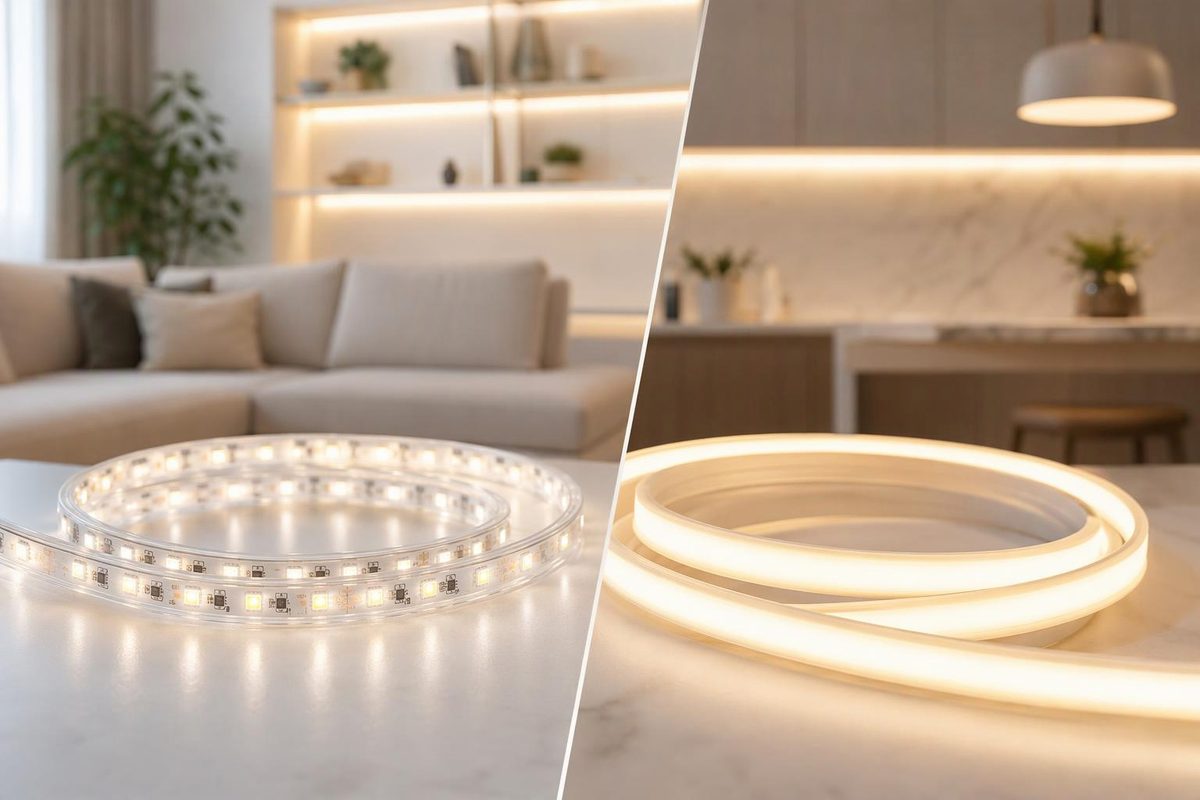
In Flexfire’s terminology, SOB means SMD-on-Board—not a typo for COB. Its Verity SOB strip uses individually packaged LEDs beneath a continuous white silicone diffuser. COB means Chip-on-Board: bare LED chips sit directly on the circuit board beneath a continuous phosphor-containing layer. Both can produce a smooth line of light; the most useful distinction is their construction and visible finish, not an automatic advantage in brightness or run length. LightNOW explains the construction difference.
Favor a white-finished SOB product when the strip will remain exposed. Favor COB when the particular product offers the dimensions, output or controls your installation needs. Neither label replaces the electrical and mechanical specifications.
What you will actually see
Conventional white-light COB tape commonly has a yellow phosphor line visible when switched off. Flexfire’s Verity SOB strip places phosphor within each individual LED package, leaving its outer silicone layer white. That makes the unpowered appearance a meaningful difference for open shelving, mirror surrounds or other locations where the strip remains visible. Flexfire describes Verity’s coating and construction.
For concealed cove lighting, that off-state difference may not matter. For a strip reflected in a glossy backsplash, assess the illuminated result as well: both technologies offer continuous-light products, so “dotless” alone does not settle the comparison.
Verity is designed to work without an additional diffuser. That does not make an aluminum channel pointless: Flexfire still identifies channels as an option for protection, a finished appearance and improved heat management. Decide separately whether you need diffusion and whether you need a mounting profile. See our guide to LED channel types and fit.
Compare actual strips—not category-wide promises
The following manufacturer/supplier ratings show why broad claims such as “COB stops at 5 m” or “SOB is always brighter” are poor buying rules. These are two static-white, indoor products, not a head-to-head test. Specifications were checked in November 2026 against Flexfire’s Verity listing and LEDSupply’s Architectural Series COB datasheet.
| Specification | Flexfire Verity SOB | LEDSupply Architectural COB white |
|---|---|---|
| Supply voltage | 24 V DC | 24 V DC |
| Rated power | 4 W/ft | 5 W/ft |
| Listed light output | 399 lm/ft at 3000 K | 427 lm/ft, white-series rating |
| CRI | 93 | 90+ |
| Maximum run | 32 ft, listed as 10 m | 32 ft |
| Listed strip/PCB width | 10 mm | 10 mm |
| Cut interval | 1 in (25 mm) | 2.46 in |
| Location rating | IP20, dry indoor | IP20 |
Here, the COB product has a higher published lumen figure, but also higher power consumption. Both list the same maximum run in feet. Verity offers the shorter cut interval—useful when fitting a strip between fixed cabinet or shelf ends.
Those differences belong to these products. They do not establish universal SOB-versus-COB limits. Likewise, claims that SOB always runs cooler, lasts longer or matches color better should not decide a purchase without comparable product data.
Which one should you buy?
Favor SOB for an exposed strip when its white unpowered finish and integrated diffusion remove a separate cover from your design. Check total height as well as width: Verity is listed at 3.5 mm high. Its coating also affects connections; Flexfire specifies compatible solderless grip connectors and says screw-terminal connectors are unsuitable for this strip. That restriction should not be generalized to every SOB product. Verity specifications and connector guidance.
Favor COB when a specific model fits the job better: a suitable width, useful cut spacing, required color options or better output for your chosen load. Do not assume every COB strip is narrower or every SOB strip permits a longer run.
Before ordering either type, match:
- Voltage and load: select the supply and controls for the actual strip voltage and total watts—not the technology label.
- Dimming: verify the strip, driver and dimmer work together; our dimming compatibility guide explains the alternatives.
- Feed layout: follow the product’s maximum-run and wiring instructions rather than treating reel length as permission for any feed arrangement.
- Location and connections: silicone diffusion is not proof of wet-location suitability. Verity’s listed indoor version is IP20; Flexfire says only specifically tested and listed IP65 versions are intended for outdoor or wet environments. Manufacturer location guidance.
The practical choice is the strip whose finish, dimensions and circuit requirements all fit—not the acronym with the strongest marketing claims.