
What Does RGBIC Mean, and Does It Control Every LED?
"IC" may mean Integrated Circuit or Independent Control. Both describe separate color zones, but the label does not promise control of every visible LED.
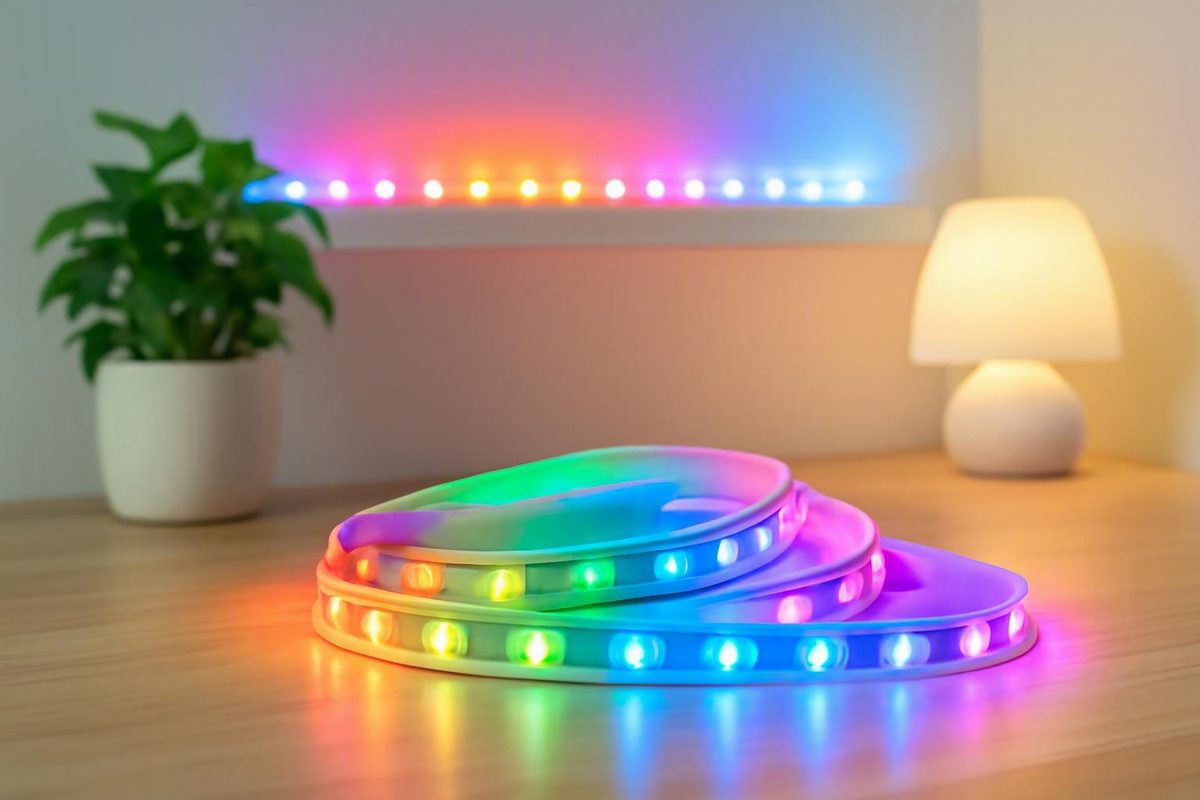
RGBIC meaning in one sentence
RGBIC refers to red, green, and blue LED lighting with integrated-circuit control, allowing separate parts of a strip or fixture to display different colors at the same time.
RGB stands for red, green, and blue. By varying the output of these three color channels, an LED can produce a broad range of colored light. In a basic non-addressable RGB strip, the controller generally applies the selected combination to the entire connected strip. If you choose purple, for example, the whole strip becomes purple.
The “IC” is not expanded consistently in product marketing. Some sellers use Integrated Circuit, while others use Independent Control. These describe two sides of the same idea:
- Integrated circuit identifies the control hardware built into or associated with the lighting.
- Independent control describes what that hardware enables: separate instructions for different LEDs or zones.
For example, Govee uses “Integrated Circuit” in its explanation of RGBIC lighting, while DeckTok uses “Independent Control.”
The clearest practical interpretation is RGB lighting in which integrated circuits provide independent control of multiple points or zones.
The visible result is straightforward. An ordinary RGB strip might be red from end to end. An RGBIC strip could instead show red at one end, blue in the middle, and green at the other. It can also move those colors between zones to create flowing or chasing animations.
That definition does not tell you everything needed to select or install a strip. The RGBIC label alone does not specify:
- Whether control is per LED or per group of LEDs
- The size of each controllable segment
- The strip voltage or power requirement
- The data protocol or connector pinout
- Which controller or app it needs
- Whether it can be cut or extended
- Whether it has a dedicated white channel
- Its brightness, efficiency, environmental rating, or color quality
Think of RGBIC as a description of the product’s color-control capability, not as a complete electrical specification.
How RGBIC control works
A conventional non-addressable RGB strip behaves as one synchronized lighting load. Its red, green, and blue channels run along the strip, and the controller adjusts those channels for the strip as a whole. Changing the balance of the three channels changes the color, but every connected section generally receives the same command.
RGBIC adds control chips associated with individual LEDs or defined sections of the strip. These circuits allow the controller to direct different color or brightness instructions to different controlled points. This capability is commonly called addressability.
In plain language, addressability means that the controller can say:
- “This point should be red.”
- “The next controlled point should be blue.”
- “The point after that should be dim green.”
The conceptual signal sequence is:
- The controller sends color and effect data.
- An integrated circuit interprets the relevant instruction.
- The associated LED or segment produces the assigned color and brightness.
The important word is associated. On one product, an IC may control a single visible LED package. On another, it may control a group containing several LEDs. Both designs can be sold as RGBIC because both provide segmented control.
That distinction affects what the strip can display. A strip with larger multi-LED zones may show more obvious blocks of color. LED count alone does not answer this question: two strips could have similar LED density but very different numbers of independently controlled zones.
Do not assume that “RGBIC” means every visible LED is individually programmable. Look for wording such as:
- Individually addressable
- Per-pixel control
- Segment or zone control
- LEDs per controllable group
- Number of addressable pixels or segments
Addressable-lighting products may use chips such as WS2812B, WS2811, WS2815, or SK6812, but the RGBIC name does not identify a particular chip, voltage, signal format, or wiring arrangement (addressable-strip overview). Two products described as RGBIC may consequently need different controllers even if their visible effects appear similar.
The most useful questions are therefore:
- What is the smallest controllable unit?
- How does the controller communicate with it?
The first determines the visual resolution of effects. The second determines electrical and controller compatibility.
RGB versus RGBIC: the difference that matters
The central difference is control granularity. A standard non-addressable RGB strip generally displays one selected color and brightness across its entire connected length. RGBIC divides the lighting into separately controlled points or zones, allowing several colors to appear simultaneously.
| Feature | Standard non-addressable RGB | RGBIC |
|---|---|---|
| Control method | Red, green, and blue channels controlled across the strip as a synchronized load | Data and control circuits assign instructions to separate LEDs or segments |
| Simultaneous colors | Generally one selected mixed color across the strip | Different controlled zones can show different colors at once |
| Typical effects | Static colors, dimming, fades, flashes, and whole-strip color transitions | Gradients, rainbows, chases, flowing colors, scanning effects, and other multizone animations |
| Controller requirements | Controller suited to the strip’s shared RGB channels | Controller compatible with the strip’s addressable design |
| Modification considerations | May be cut at documented intervals, depending on the model | Cutting and reconnection depend on control-group boundaries and product instructions |
| Best-fit use | Uniform accent light or synchronized background wash | Simultaneous multicolor displays and moving effects |
Ordinary RGB can still change colors. It may fade from red to blue, flash in time with a controller, or cycle through a palette. Its limitation is not a lack of color changing; it is that the strip generally performs those changes as one synchronized unit.
RGBIC can assign colors to separate zones, enabling effects such as:
- A stationary rainbow extending along the strip
- A color chase traveling from one end to the other
- A gradient blending between several zones
- A scanning point or band of light
- Multiple flowing colors
- Multizone patterns reacting to music or other controller input
The right choice depends on the intended effect. Standard RGB may be entirely sufficient behind a headboard, under a shelf, or around a room where the goal is a uniform color wash. RGBIC becomes useful when the pattern needs to vary along the strip itself.
RGBIC products contain additional control circuitry and are often positioned above basic RGB products, but that does not make them universally better. Added control can also mean more compatibility questions and more restrictions on modification.
Compare those characteristics separately.
RGBIC, RGBW, RGBICW, and RGBICWW explained
Basic RGBIC uses red, green, and blue color channels with segmented control. It does not inherently include a dedicated white LED channel.
An RGB light can approximate white by running its red, green, and blue channels together. That mixed white may be useful within an effect, but it can appear bluish or otherwise tinted. It should not automatically be treated as equivalent to light from a dedicated white LED.
Extra “W” letters usually identify additional white-light channels:
- RGBW combines RGB color channels with a dedicated white channel. RGBW does not necessarily mean addressable; a conventional RGBW strip can still operate uniformly across its entire length.
- RGBICW combines segmented RGBIC color control with a dedicated white channel, commonly described in this naming scheme as cool white.
- RGBICWW generally adds dedicated cool-white and warm-white channels, providing a broader choice of white light than RGB mixing alone.
| Type | Multizone color capability | Dedicated white channel | Practical emphasis |
|---|---|---|---|
| RGB | No, for conventional non-addressable products | No | Uniform color-changing accent light |
| RGBW | Not implied by the name | Yes, one white channel | Color effects plus a dedicated white |
| RGBIC | Yes, by controlled LEDs or segments | No | Animated and simultaneous multicolor effects |
| RGBICW | Yes | Yes, typically cool white | Segmented colors plus dedicated white illumination |
| RGBICWW | Yes | Typically separate cool-white and warm-white channels | Segmented colors with a broader choice of dedicated whites |
Naming is not perfectly consistent across manufacturers. “WW” may be used differently in different catalogs, and some product families use other abbreviations for warm white, cool white, or adjustable-white capability. Confirm the channels listed on the exact specification sheet rather than selecting by acronym alone.
If the strip will mainly provide decorative color, basic RGBIC may be enough. If it must also serve as everyday or task illumination, prioritize a model with a dedicated white channel and evaluate that channel’s specifications separately. RGBIC’s ability to animate color does not establish the tint, brightness, color quality, or usefulness of its white light.
What RGBIC is good for—and when ordinary RGB is enough
RGBIC is useful when the design depends on different parts of the light doing different things. Common examples include:
- Gaming and streaming setups
- Entertainment areas
- Party lighting
- Stage and event displays
- Decorative wall or ceiling features
- Display cabinets and themed installations
- Animated backlighting
Gradients, chases, flowing patterns, and scanning effects all need spatial control. A chase works because one zone brightens while another dims. A gradient works because neighboring zones receive different color mixtures. A music-reactive scene can vary separate regions instead of pulsing the entire strip as one block. Manufacturer guidance identifies bars, stages, parties, and background lighting as common contexts for these effects (examples of IC-controlled lighting effects).
Ordinary RGB remains a reasonable choice when you want:
- One uniform color around a room
- A simple background glow
- Basic whole-strip fades or color changes
- Straightforward accent lighting
- A project that does not benefit from moving patterns
Choosing standard RGB in those cases is not settling for inferior technology. It is selecting the simpler control method that matches the intended effect.
Keep color-effects capability separate from general lighting performance. Being able to display several animated colors does not establish brightness, white-light quality, color accuracy, electrical efficiency, heat management, adhesive quality, durability, or environmental suitability.
A sophisticated rainbow effect cannot compensate for inadequate output where functional illumination is required. Likewise, a strip intended for everyday white lighting should not be selected solely because its app offers attractive animations.
The concise decision rule is:
- Choose RGBIC for segmented, simultaneous, or moving color effects.
- Choose standard RGB for simpler synchronized color.
- Choose a version with dedicated white channels when useful white illumination matters.
Controller and compatibility requirements
An RGBIC strip needs a controller capable of communicating with its particular control design. A conventional RGB controller should not be assumed compatible.
At a high level, the system is typically arranged as:
Power source → compatible controller → RGBIC strip
The controller generates the color and effect instructions, while the power source supplies the required electrical power. This conceptual order is not a substitute for the exact product wiring diagram.
“RGBIC” alone does not reveal:
- Rated voltage
- Data protocol
- Number or function of conductors
- Connector type
- Connector pinout
- Required controller
- Supported app
- Hub requirements
- Smart-home compatibility
- Maximum strip length or segment count
A plug that physically fits does not establish compatibility. Match components by their documented specifications, not by connector appearance or the shared RGBIC label.
Before buying a strip, controller, extension, or replacement power source, verify:
- Rated voltage: Confirm that the strip, controller, and power arrangement are intended for the same system.
- Control protocol: The controller must generate the signal expected by the strip.
- Connector and pinout: Confirm both physical fit and conductor functions.
- Supported controller: Use documented controller models or types.
- Controllable segment size: Determine whether control is per LED or per group.
- App or hub requirements: Check what is needed for setup and daily control.
- Available effects: Confirm that the controller provides the effects you want.
- Power requirements: Use the manufacturer’s specifications for the exact installed length and configuration.
Commercial technical guidance likewise distinguishes addressable RGBIC controllers from controllers intended for conventional RGB strips (controller and strip-type guidance).
User control also varies. Some systems expose individual zones and allow detailed pattern design. Others mainly provide preset scenes even though the underlying strip is segmented.
Controller compatibility can therefore matter more than the RGBIC marketing term. Exact documentation must establish that a particular controller, app, hub, or smart-home platform works with the strip. Do not infer compatibility from another RGBIC product simply because the language or visible effects appear similar.
Can RGBIC strips be cut, extended, or reconnected?
Cuttability is model-specific. Some RGBIC strips are not designed to be cut. Others permit cutting only at designated marks or at the boundaries of complete controlled groups.
Ordinary RGB cutting assumptions should not automatically be applied to RGBIC. An addressable strip contains control circuits and a defined arrangement of data paths, LEDs, and segments. A cut outside the permitted location may interrupt the intended circuit or separate a control chip from the LEDs associated with it.
If a manufacturer explicitly allows cutting:
- Read the instructions for the exact model and revision.
- Identify the documented cut marks.
- Confirm whether the cut must fall at a complete segment boundary.
- Check whether the remaining section is supported by the controller.
- Use only documented connectors or reconnection methods.
- Verify whether modification changes warranty or environmental protection.
Copper pads or a printed line do not, by themselves, prove that user cutting is supported. Even if a modified strip still illuminates, the available evidence does not establish that addressing, animations, environmental protection, or warranty coverage will remain intact.
Manufacturer and retailer guidance reflects this model-level variation: many addressable strips cannot be cut arbitrarily, while some designs permit cutting only at designated group positions (model-specific cutting comparison).
Extension and reconnection introduce further questions:
- Is the extension cable wired for the same connector and pinout?
- Is the required data direction preserved?
- Can the controller support the revised number of zones?
- Does the power arrangement support the new total length?
- Does the manufacturer require a particular extension method?
- Will preset and custom effects map correctly to the revised layout?
- Is a compatible connector or joining method documented?
There is no universal promise that dynamic effects will continue working after an RGBIC strip is cut, extended, or reconnected. There is also no universal rule that RGBIC can never be modified.
The reliable answer is: modify a strip only where and how its exact documentation permits. Keep DIY work within the documented low-voltage LED system. Work involving line voltage or an electrical panel falls outside this type of strip-light modification and should be left to an appropriately qualified electrician (low-voltage scope and electrical-work notice).
A practical RGBIC buying checklist
Use this checklist while reading a product page or specification sheet. If a critical detail is absent, ask the seller or manufacturer before buying rather than filling the gap with assumptions about the RGBIC name.
Control resolution
- [ ] Is the strip controlled per LED, per pixel, or per multi-LED segment?
- [ ] If control is segmented, how many LEDs belong to each controllable group?
- [ ] How many controllable points or zones are present over the intended length?
- [ ] Is zone control available to the user or used only internally for preset scenes?
- [ ] Is the visual resolution fine enough for the desired gradients and animations?
A high LED count is not the same as a high addressable-pixel count. Evaluate the smallest controllable unit.
Electrical and controller compatibility
- [ ] What is the strip’s rated voltage?
- [ ] Which data or control protocol does it use?
- [ ] What connector and pinout are required?
- [ ] Which controller models or types are supported?
- [ ] Is the controller included?
- [ ] Does the system require a particular app, account, hub, or network connection?
- [ ] Is compatibility with the desired smart-home platform explicitly documented?
Do not match components solely because each is described as RGBIC, digital, or addressable.
Effects and user control
- [ ] Can you create and edit zones yourself?
- [ ] Can you set colors for individual LEDs or only for groups?
- [ ] Are gradients, chases, or music-reactive modes customizable?
- [ ] Are the desired effects available only as fixed presets?
- [ ] Can animation speed, direction, brightness, and palette be changed?
- [ ] Will the controls remain practical after the strip is installed?
The difference between customizable zones and a catalog of preset animations can be more important than the advertised number of effects.
Cutting, extension, and layout
- [ ] Is cutting explicitly allowed for this exact model?
- [ ] Where are the documented cut points?
- [ ] Do those points align with complete control groups?
- [ ] Are compatible reconnection methods documented?
- [ ] Can the strip be extended?
- [ ] What is the maximum supported layout or length?
- [ ] Can the controller recognize the revised length or segment count?
- [ ] Will modification affect environmental sealing or warranty coverage?
If the specification says nothing about cutting, do not assume that visible copper pads constitute permission.
White-light capability
- [ ] Does the product contain only red, green, and blue channels?
- [ ] Does it have a dedicated white channel?
- [ ] Is that white channel cool white, warm white, or adjustable between the two?
- [ ] Is the white output intended only as part of an effect or for everyday illumination?
- [ ] Are relevant white-light specifications supplied for the exact product?
Choose RGBICW, RGBICWW, or another clearly specified configuration if dedicated white is important. Basic RGBIC should not be assumed to provide white comparable to a dedicated white LED.
Power and physical installation
- [ ] What are the power requirements for the exact installed length?
- [ ] Does the supplied power source support the intended configuration?
- [ ] Are there manufacturer limits on extensions, branches, or total segment count?
- [ ] Is the strip width suitable for the mounting location or channel?
- [ ] Are connectors and turns accounted for in the layout?
Do not infer power needs from the RGBIC label.
Environment
- [ ] Is the product rated for the intended indoor, outdoor, damp, or water-adjacent location?
- [ ] Are the connectors, controller, and power components suitable for the same environment?
- [ ] Will cutting or joining compromise the product’s enclosure or seal?
- [ ] Does the manufacturer specify how modified ends and joints must be protected?
RGBIC describes color control, not environmental protection. It does not establish an enclosure or water-resistance rating. For outdoor or water-adjacent projects, verify the rating and installation requirements for the complete system, including joints, connectors, controller, and power components. See this guide to water-resistant LED strips and IP ratings for the separate environmental considerations.
Before buying, confirm the exact product’s control resolution, voltage, protocol, pinout, controller, cut points, white channels, power requirements, and environmental rating. None of those details is guaranteed by the RGBIC label.
Frequently asked questions
Does IC in RGBIC mean integrated circuit or independent control?
Both expansions appear in seller terminology, but they describe different aspects of the same feature. Integrated circuit identifies the hardware, while independent control describes the segmented control that the hardware enables.
Because RGBIC is a market-facing label rather than a standardized electrical specification, it is more useful to explain the mechanism and capability than to insist that every manufacturer uses the same expansion.
Can RGBIC display multiple colors at the same time?
Yes. That is the main practical distinction between RGBIC and conventional non-addressable RGB. Integrated circuits let the controller assign different colors to separate LEDs or zones, so one strip can show several colors simultaneously.
The exact visual resolution depends on segment size. A strip that controls each LED can create finer transitions than one that controls larger groups, even though both may be labeled RGBIC.
Does every RGBIC LED have independent control?
No. Some products provide individual LED or pixel control, while others control multi-LED segments. The RGBIC name establishes segmented control but does not guarantee that every visible LED can receive a separate instruction.
Check the specification for the number of addressable pixels, controllable zones, or LEDs per segment. If that information is missing, ask the manufacturer before assuming per-LED programmability.
Can RGBIC strips be cut and reconnected?
Some can; some cannot. A cuttable model may allow cuts only at marked points or complete segment boundaries. Reconnection may require a documented connector, the correct data direction, a compatible pinout, and controller support for the revised layout.
Never rely on the RGBIC label or copper-pad appearance alone. Follow the instructions for the exact model, and do not assume animations, addressing, environmental protection, or warranty coverage will remain unchanged after modification.
Are RGBIC, ARGB, DRGB, digital LED, and pixel LED the same thing?
These terms are sometimes used for similar addressable-lighting concepts, but they are not universally interchangeable specifications. In broad commercial usage, they may refer to lighting in which separate pixels or segments receive different instructions. Some suppliers consequently use “RGBIC,” “digital LED,” or “pixel LED” for related product categories (digital and pixel LED terminology).
The names do not guarantee the same voltage, protocol, connector, pinout, control resolution, or controller compatibility. Treat them as clues that a product may be addressable, then confirm its exact electrical and control specifications before combining components.
The useful meaning of RGBIC is not simply “more colors.” It is separately controlled color zones made possible by integrated circuits. That makes RGBIC a logical choice for gradients, chases, rainbows, and simultaneous multicolor effects, while ordinary RGB remains suitable for uniform color.
Before purchasing or modifying either type, verify the exact product’s segment size, controller, voltage, protocol, connector pinout, cut points, power requirements, and dedicated white channels. The RGBIC label alone does not establish brightness, efficiency, lifespan, waterproofing, color quality, ecosystem support, segment size, or cuttability.