
Are 9005 and 9007 Bulbs Interchangeable? No—Here’s Why
No. A 9005 bulb cannot directly replace a 9007 bulb, and a 9007 cannot directly replace a 9005.
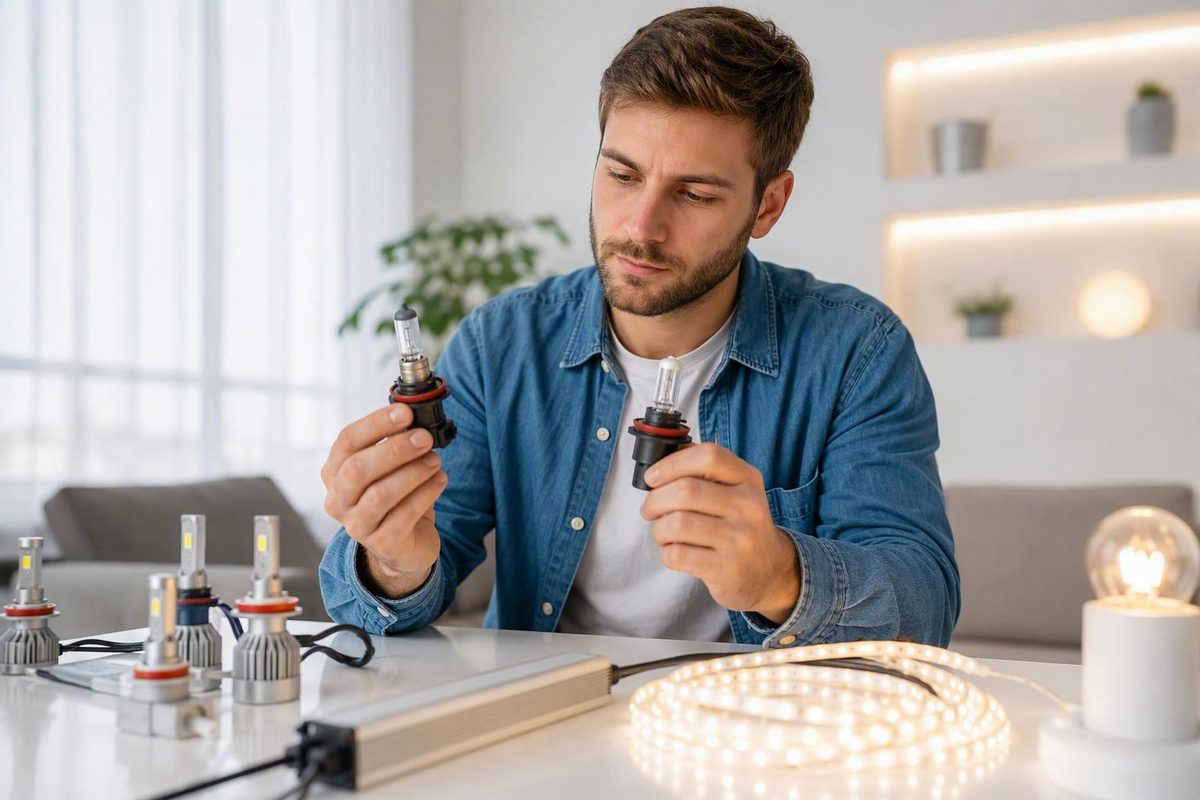
The short answer: 9005 and 9007 are not interchangeable
No. A 9005 bulb cannot directly replace a 9007 bulb, and a 9007 cannot directly replace a 9005.
The decisive differences are their bases and beam functions:
- 9005, also called HB3, uses a P20d base and provides a single beam function.
- 9007, also called HB5, uses a PX29t base and provides both high- and low-beam functions.
These classifications appear separately in HID Nation’s headlight bulb cross-reference chart. Because the bulbs use different base standards, neither should be expected to mount correctly in a headlamp designed for the other. Their different operating roles also mean that adapting a connector would not make them functionally equivalent.
Direct replacement requires more than similar dimensions or power ratings. The bulb must:
- Fit the headlamp’s mounting interface
- Work with the existing socket and controls
- Perform the required beam function
- Match the vehicle’s exact headlamp configuration
This is especially important in a 9007 application. A compatible headlamp uses one 9007 bulb for both low and high beams. A single-beam 9005 cannot take over both roles merely because its bulb number looks similar or one nominal wattage figure is close.
The reverse substitution is also incorrect. A dual-beam 9007 does not become a suitable dedicated 9005 replacement when placed—or attempted to be placed—in a system designed for a single-beam 9005.
For a routine replacement, use the bulb designation specified for the exact vehicle, headlamp option, and beam position. Do not select a bulb by visual resemblance, a nearby part number, or wattage alone.
9005 vs. 9007 specifications at a glance
| Specification | 9005 | 9007 |
|---|---|---|
| Standardized alias | HB3 | HB5 |
| Base | P20d | PX29t |
| Beam function | Single beam | Dual beam |
| Nominal wattage | 60W or 65W | 65W high beam; 55W low beam |
| Typical application | Commonly a high beam; also listed for some fog-light applications | One bulb providing high and low beams in a compatible headlamp |
The aliases, bases, beam functions, nominal wattages, and typical applications above come from a retailer-published 9005 and 9007 comparison chart. The chart is useful for comparing bulb families, but it does not establish fitment for any unnamed vehicle.
HB3 is an alias for 9005. If a vehicle specifies 9005 and a replacement package identifies its bulb as HB3, those labels refer to the same bulb family.
HB5 is an alias for 9007. A product labeled HB5 may therefore be relevant when the vehicle specifies 9007.
HB3 and HB5 are not alternate names for the same bulb. They identify different types, just as 9005 and 9007 do.
The beam-function difference is equally important. A 9005 provides one beam function and is commonly associated with a dedicated high-beam position, although the cited chart also lists some fog-light applications. Actual use remains vehicle-specific.
A 9007 is a dual-beam bulb. In a headlamp designed around it, one bulb serves both the low- and high-beam functions.
Finally, wattage is a comparison value, not a fitment rule. The cited ratings of 60W or 65W for 9005 and 65W high/55W low for 9007 do not make the bulbs’ bases, functions, or headlamp requirements equivalent.
Why similar numbers and wattages do not make the bulbs compatible
Automotive bulb numbers are not a sequence in which nearby numbers identify interchangeable parts. Although “9005” and “9007” look related, each designation refers to a particular bulb configuration and operating role.
A bulb designation helps distinguish several compatibility factors:
- Mounting base: The bulb must use the base required by the headlamp.
- Socket and electrical control: The vehicle must connect to and control the intended bulb configuration.
- Headlamp arrangement: The housing must be designed for either a dedicated single-beam position or a combined dual-beam position.
- Beam function: The replacement must perform the function expected at that location.
- Vehicle-specific fitment: Model year, trim, headlamp option, and beam position can affect the correct selection.
For 9005 and 9007, the base difference alone prevents a direct swap. A P20d bulb is not the same mounting type as a PX29t bulb. A 9005 therefore should not be expected to lock into a headlamp designed for a 9007, and a 9007 should not be expected to mount where a 9005 belongs.
Their operating roles independently rule out interchangeability. A 9005 supplies one beam function. A 9007 is used in a system where one bulb position supplies both low and high beams.
Consider a vehicle that uses one 9007 in each headlamp. That bulb position must provide low beam during one operating state and high beam during another. Replacing it with a single-beam 9005 would not preserve that combined function.
The inverse is also true. If a headlamp has a dedicated 9005 high-beam position and a separate low-beam bulb, the dual-beam capability of a 9007 does not make it a correct replacement. The existing housing, mounting interface, and controls remain designed around the original arrangement.
This is why similar nominal wattage does not prove compatibility. A bulb can consume a similar amount of power while remaining mechanically and functionally wrong for the application.
The same caution applies to broad product descriptions such as “9000-series compatible.” The individual designation matters. A listing for 9005/HB3 does not automatically include 9007/HB5.
A bulb swap is not the same as a headlamp-system conversion
Direct interchangeability means removing the existing bulb and installing another in the same socket and housing without redesigning the system. The replacement must mount correctly and perform the required function through the existing arrangement.
9005 and 9007 do not meet that definition.
Changing a vehicle from one overall headlamp arrangement to another may be possible in some circumstances, but that would be a system conversion—not evidence that the individual bulbs are interchangeable.
A narrow example appears in a 2016 Mitsubishi Galant conversion discussion. The vehicle under discussion had an assembly using separate 9005 high-beam and 9006 low-beam bulbs, while another Galant headlamp configuration used one 9007 for both functions. The proposed project involved changing the assembly and combining formerly separate beam circuits. It did not involve inserting a 9007 into an existing 9005 socket.
That kind of project would require, at minimum:
- A headlamp assembly designed for the intended bulb
- A suitable socket and mounting arrangement
- Correct control of the low- and high-beam states
- Vehicle-specific electrical integration
- Confirmation that the assembly fits the exact vehicle
Optics, physical clearance, heat management, and any applicable installation or road-use requirements would also need authoritative vehicle- and product-specific answers. The available sources do not resolve those questions.
The forum discussion does not identify a tested or manufacturer-approved conversion harness. It also does not provide a universal conversion procedure. Its example should not be generalized to other vehicles—or treated as definitive instructions for the particular vehicle discussed.
A completed conversion would replace one headlamp architecture with another. Before conversion, a vehicle might have separate low- and high-beam bulbs. After a properly documented conversion, it might use one dual-beam bulb in a compatible assembly. At no point does that make a loose 9005 interchangeable with a loose 9007.
Product terminology can obscure this distinction:
- A replacement bulb should match the specified bulb family and position.
- A socket adapter may address only part of the interface.
- A conversion harness would need to support the vehicle’s control arrangement.
- A complete headlamp conversion may involve the housing, mounting, wiring, and beam functions.
An item marketed as an “adapter” does not, by itself, turn two different bulb standards into direct substitutes.
Why an improvised adapter is not an established solution
The available evidence does not identify a tested or manufacturer-approved universal adapter that makes 9005 and 9007 bulbs safely interchangeable.
A connector adapter would address only one part of the mismatch. It would not change the bulbs’ different bases or operating roles. Where a vehicle originally uses separate high- and low-beam bulbs, adapting it to one dual-beam bulb also requires the two beam states to be controlled as intended.
Respondents in the 2016 enthusiast discussion cautioned that a straightforward wiring approach might energize both 9007 filaments when high beam was selected. They warned that this could rupture the bulb or damage the headlamp. This is an unverified technical judgment from forum participants, not a manufacturer finding or a controlled test result.
The discussion does not establish that simultaneous operation would definitely cause failure, how quickly a failure might occur, or what conditions would produce it. It also does not prove the behavior of any other vehicle.
For that reason, do not treat a generic wiring diagram or forum post as sufficient validation for a conversion. Avoid attempting to make the bulbs fit by:
- Trimming mounting tabs
- Forcing a bulb into the opening
- Altering the original socket
- Splicing wiring from an unverified diagram
- Building a generic adapter without authoritative vehicle information
Anyone considering a broader conversion should look for vehicle-specific components and instructions documented by the relevant manufacturer. If no authoritative pathway is available, consult a qualified automotive-lighting or automotive-electrical professional who can evaluate the complete proposed system rather than only its connectors.
How to verify the correct bulb before buying
The general differences between 9005 and 9007 cannot determine which bulb an unnamed vehicle requires. Fitment must be checked for the specific vehicle, headlamp option, and beam position.
Use the following sequence before purchasing a replacement.
1. Check the owner’s manual
Look in the maintenance, specifications, or bulb-replacement section. Identify the entry for the exact position being serviced.
Do not stop at the first headlight listing. A vehicle may use different bulb types for high and low beams, and it may have separate listings for fog lights or different headlamp packages.
Record the full description when available. “9005/HB3 high beam” is more useful than a note that says only “headlight bulb.”
2. Read the designation on the installed bulb
Inspect the accessible bulb for a printed or molded code. A clear 9005 or HB3 marking points to one bulb family; a 9007 or HB5 marking points to another.
Treat this as a cross-check rather than sole authority. An earlier owner may have changed the headlamp assembly or installed the wrong bulb.
3. Confirm the complete vehicle configuration
Use all relevant fitment details:
- Model year
- Make
- Model
- Trim or submodel
- Headlamp option
- Intended beam position
Do not assume every trim or lighting package within the same model year uses the same bulb arrangement.
4. Check a reputable fitment catalog
Enter the complete vehicle information into a catalog from the vehicle manufacturer, a bulb manufacturer, or an established parts supplier. Confirm that the result applies to the position being serviced.
A listing for “9005 high beam” does not establish that 9005 fits the low-beam position. General search results may also combine products for different beam positions or optional headlamp systems.
5. Match the replacement listing
Confirm that the package or product listing uses the same bulb-family designation:
- 9005 / HB3
- 9007 / HB5
A matching designation is necessary, but it does not prove that every aftermarket product will suit every vehicle or housing. Follow the product manufacturer’s vehicle-specific fitment information and installation limitations.
6. Resolve disagreements before buying
If the manual, installed bulb, and fitment catalog disagree, stop rather than choosing whichever bulb looks closest.
Possible explanations include:
- The wrong beam position was selected
- The vehicle has an optional headlamp package
- The trim information is incorrect
- The headlamp assembly was previously replaced
- The installed bulb is wrong
- The catalog result is incomplete
Where possible, verify the headlamp assembly itself or contact the vehicle manufacturer, a dealer parts department, or a qualified technician. Provide the complete vehicle details and identify the exact headlamp position being serviced.
If you have already bought the wrong bulb, return or exchange it. Do not trim the base, force it into place, modify the socket, or improvise wiring.
The sensible replacement or upgrade path
For an ordinary failed-bulb replacement, the sensible rule is simple: replace like with like.
If the vehicle specifies 9005, buy the appropriate 9005/HB3 product for that position. If it specifies 9007, buy the appropriate 9007/HB5 product. Do not move between those families because of price, availability, appearance, or similar wattage.
Matching the designation identifies the relevant bulb family, but it is not the end of product validation. Check the product manufacturer’s fitment information for the exact vehicle and headlamp rather than relying solely on “9005,” “HB3,” “9007,” or “HB5” in a product title.
If the goal is to move from separate high- and low-beam bulbs to one combined dual-beam bulb, treat the change as a complete vehicle-specific headlamp project. It is not a routine bulb upgrade.
Before proceeding, authoritative documentation would need to answer questions such as:
- Is there a compatible headlamp assembly for the exact vehicle and trim?
- Is that assembly intended for the vehicle’s mounting arrangement?
- How will the original and proposed beam functions be controlled?
- Are documented vehicle-specific connectors or harnesses available?
- Does the proposed installation have the required physical clearance?
- How does the complete assembly address heat management?
- Is the housing designed for the proposed bulb configuration?
- What installation and road-use requirements apply in the relevant jurisdiction?
The available comparison chart and forum discussion do not answer those vehicle-specific questions. They establish only the central distinction: 9005 and 9007 use different bases and perform different operating roles, while changing from separate bulbs to a dual-beam arrangement is a system conversion.
Where a conversion is authoritatively supported, use the documented vehicle-specific assembly and components rather than an improvised adapter. Otherwise, retain the original headlamp architecture.
Replace like with like unless authoritative documentation for the exact vehicle supports a complete conversion.
Frequently asked questions
Will a 9005 bulb physically fit a 9007 socket?
It should not be expected to fit correctly. A 9005 uses a P20d base, while a 9007 uses a PX29t base. They are different mounting types.
Do not force the bulb, trim its tabs, or modify the socket. Even if an alteration allowed the bulb to enter the opening, a 9005 would remain a single-beam bulb and could not directly perform the dual-beam role expected in a 9007 headlamp.
Are 9005 and HB3 the same bulb type?
Yes. HB3 is an alias for the 9005 bulb family. It is a single-beam bulb with a P20d base.
Do not confuse HB3 with HB5. HB5 is the alias for 9007, a different dual-beam bulb using a PX29t base.
Can a 9007 replace both a 9005 high beam and a 9006 low beam?
Not as a direct bulb replacement. A system using separate 9005 high-beam and 9006 low-beam bulbs has a different headlamp arrangement from one using a single 9007 for both functions.
Changing between those arrangements would require a compatible headlamp assembly and correctly engineered control of the two beam states. It would be a vehicle-specific housing-and-wiring conversion, not a matter of plugging a 9007 into either existing socket.
Can an adapter make 9005 and 9007 bulbs interchangeable?
No tested or manufacturer-approved universal adapter is established by the available evidence. An adapter that merely joins connectors would not necessarily address the different bases, headlamp configurations, and beam-control requirements.
Do not rely on generic wiring diagrams or improvised splices. A proposed conversion should use authoritative, vehicle-specific components and guidance or be evaluated by a qualified automotive-lighting or automotive-electrical professional.
How do I know which headlight bulb my vehicle needs?
Check the owner’s manual, the designation on the installed bulb, a reputable fitment catalog, and the replacement product listing. Confirm the exact year, make, model, trim, headlamp option, and beam position.
Remember that high and low beams may use different bulb types. If the sources disagree, stop before buying and verify the headlamp assembly through the vehicle manufacturer, a dealer parts department, or a qualified technician.
In plain language, 9005 and 9007 bulbs are different standards and are not direct substitutes. A 9005/HB3 is a P20d single-beam bulb, while a 9007/HB5 is a PX29t dual-beam bulb serving both high and low beams. Similar nominal wattage does not erase those differences. Install the type specified for the exact vehicle, and treat any move between separate 9005/9006 bulbs and one 9007 as a complete vehicle-specific headlamp conversion—not an adapter-assisted bulb swap.