
1156 vs 1157 Bulbs: Contacts, Pin Layout and Functions
A bulb entering the socket or lighting once does not prove it locks correctly, maintains reliable contact, or is compatible with the lamp assembly.
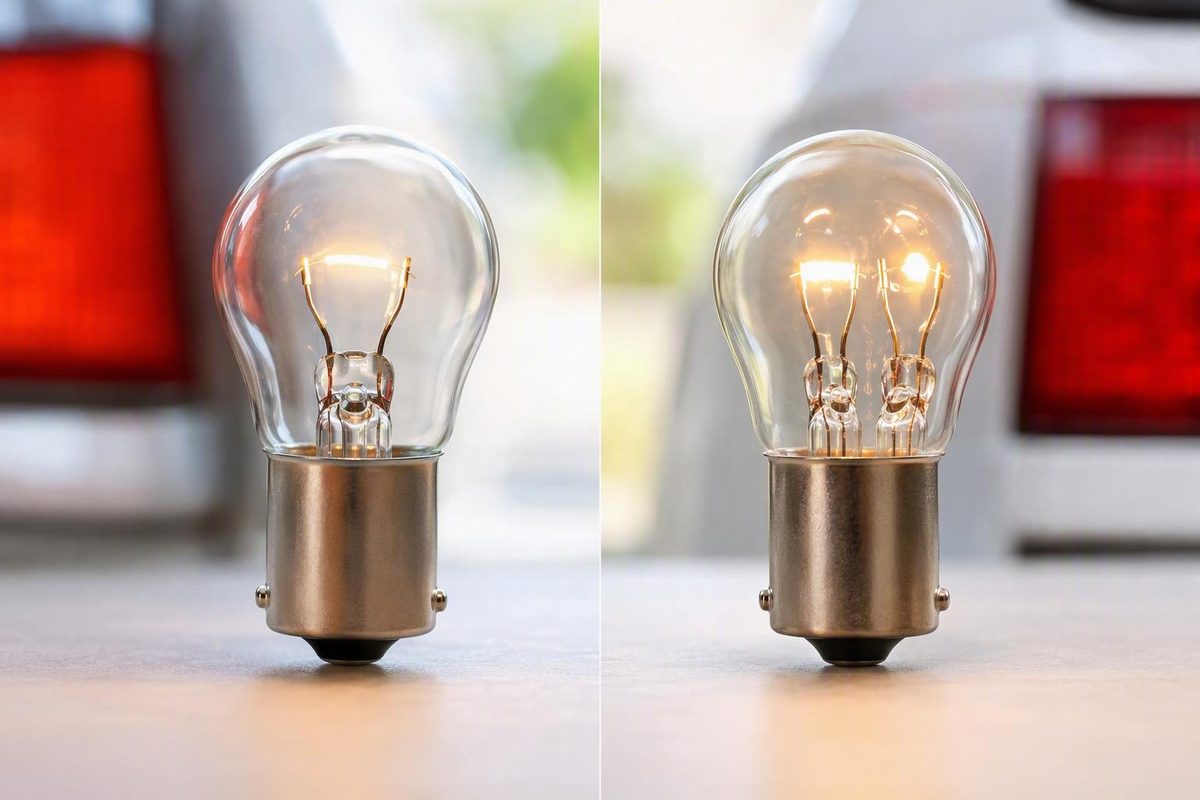
1156 vs 1157 at a Glance
The simplest difference is functional and physical: a conventional incandescent 1156 has one filament and one brightness level, while a conventional incandescent 1157 has two filaments and two brightness levels. The 1156 normally uses a single-contact BA15S base with level side pins; the 1157 commonly uses a dual-contact BAY15D base with vertically offset side pins. These differences are documented in an automotive bayonet-base guide.
| Feature | 1156 bulb | 1157 bulb |
|---|---|---|
| Normal base designation | BA15S | BAY15D |
| Bottom contacts | One | Two |
| Side-pin alignment | Opposite pins at equal heights | Opposite pins at different heights |
| Conventional filament count | One | Two |
| Brightness levels | One | Two |
| Circuit capability | Generally one function or intensity | Can support low- and high-intensity functions |
| Typical applications | Reverse lights, separate turn signals, and some standalone brake or parking lights | Combined tail/brake, parking/turn, and other dual-intensity lamps |
| Direct interchangeability | Not a direct substitute for 1157 | Not a direct substitute for 1156 |
Both bulbs belong to the broader 15 mm bayonet-base family, which explains why they can look alike from a distance. Their bottom contacts and locating pins differ, however, so their shared family size does not make them interchangeable. A BA15-family comparison identifies the 1156 as a single-contact, level-pin bulb and the 1157 as a dual-contact bulb with offset pins.
Functionally, an 1156 generally serves one circuit or nominal intensity. An 1157 can support two intensities in the same lamp assembly—for example, dim tail lighting and brighter brake lighting, or parking-light and turn-signal functions.
Those applications are typical, not universal. A turn signal is not automatically an 1156 application, and a brake light is not automatically an 1157 application. Manufacturers can separate or combine lighting functions differently among vehicles and lamp assemblies.
Short buying rule: Match the original bulb number, base, bottom contacts, side-pin geometry, socket, required functions, and vehicle documentation. Do not choose between an 1156 and an 1157 solely from the lamp’s location, the bulb’s diameter, or a product photograph.
How the Bases and Electrical Contacts Differ
Both bulbs use a bayonet-style installation method. The cylindrical metal base enters the socket, and a short twist locks the bulb against its side pins. Those pins do more than retain the bulb: their placement helps align the appropriate base with the intended socket.
An 1156 normally uses a BA15S base:
- One electrical contact is centered on the bottom.
- Two side pins sit opposite one another.
- The side pins are at the same vertical height.
- The bulb provides one principal light-producing path or intensity.
An 1157 commonly uses a BAY15D base:
- Two separate electrical contacts appear on the bottom.
- Two side pins sit on opposite sides of the base.
- One pin is vertically higher than the other.
- The bulb can support two independently selected light-producing paths or intensity states.
The bottom view is usually the quickest clue. One insulated contact indicates the normal 1156 arrangement; two separate contacts indicate the normal 1157 arrangement. Then check the side view. Equal-height pins point to an 1156-style BA15S base, while different-height pins point to an 1157-style BAY15D base. The illustrated base descriptions from Super Bright LEDs confirm these contact and pin differences.
A labeled comparison should show the following:
BOTTOM VIEW                         SIDE VIEW

1156 / BA15S                       1156 / BA15S
     _______                         pin ──┐   ┌── pin
/ │ │
  |     ●     |  one contact              └───┘
\_________/ equal pin heights


1157 / BAY15D                     1157 / BAY15D
     _______                         pin ──┐
/ │
  |    ● ●    |  two contacts             └───┐
\_________/ └── pin
                                         offset pin heights
A complete comparison graphic should also show the corresponding socket terminals and bayonet slots: one bottom terminal and level slots for the normal 1156 arrangement, versus two terminals and offset-height slots for the normal 1157 arrangement.
The bottom contacts and side pins have different jobs. The contacts meet the socket’s electrical terminals, while the pins locate and retain the base. Correct diameter is therefore only one part of fitment.
Some seller pages and tables shorten the 1157 designation to BA15D, while others use the more specific BAY15D when describing its offset-height pins. For this comparison, BAY15D is the clearer label for the normal 1157 configuration. A listing that says only BA15D should be verified by checking its contact count, pin geometry, and stated vehicle fitment rather than accepted or rejected from the name alone.
Do not confuse an 1156/BA15S with BAU15S. Both are single-contact bases, but BAU15S uses a different angular relationship between its side pins. A comparison of 1156, 1157, and BAU15S bases distinguishes the opposite-pin BA15S arrangement from the differently angled BAU15S arrangement.
Inspect the socket as well as the removed bulb. If the bulb, socket, and vehicle documentation do not agree, investigate the mismatch rather than assuming the installed bulb is correct.
Why One Bulb Has One Brightness and the Other Has Two
A conventional incandescent 1156 contains one filament. When its circuit is energized, current passes through that principal light-producing path, giving the bulb one nominal intensity state: on or off.
A conventional incandescent 1157 contains two filaments associated with its two bottom contacts. The lamp assembly can select a lower-intensity or higher-intensity path, allowing one bulb package to perform two related lighting roles.
A combined rear lamp is the clearest example. The lower-intensity state may glow whenever the tail lights are on. When the driver applies the brakes, the lamp can activate a higher-intensity state. One bulb position can therefore participate in both tail and brake operation.
A front combination lamp can use the same capability differently. Its lower-intensity state may serve as a parking light, while its higher-intensity state flashes as a turn signal. This is why describing every 1157 as a “brake-light bulb” is misleading.
Construction and vehicle behavior are not identical. An 1157 package provides the physical capability for two intensity states, but the vehicle’s socket and wiring determine which states are used. Some installations may contain an 1157-shaped bulb while connecting only one available function, so finding an 1157 does not by itself prove that both brightness levels are active. A commercial comparison of these bulb families likewise notes that vehicle wiring and fitment must be checked rather than inferred from the bulb package alone.
The words single-filament and dual-filament literally describe incandescent construction. LED replacements do not contain conventional glowing filaments. Their electronics and LED arrangement must instead reproduce the required single- or dual-intensity behavior through the correct contacts.
Two brightness states should not be interpreted as a universal measured ratio. The lower and higher states may behave differently among products, lamp housings, lenses, and operating conditions. The available evidence does not establish one universal output, wattage, current, or brightness ratio for every bulb sold under these numbers.
The practical distinction is:
- 1156: one bottom contact associated with one nominal light-producing intensity.
- 1157: two bottom contacts capable of supporting lower and higher light-producing states.
- Actual operation: determined by the socket, wiring, controls, and lamp assembly.
Where 1156 and 1157 Bulbs Are Commonly Used
Application lists help explain each design, but they are not vehicle-specific fitment rules.
An 1156 is commonly found where one lamp needs one function or intensity, including:
- Reverse lamps
- Separate rear or front turn signals
- Standalone brake-light positions
- Standalone parking-light positions
- Other single-intensity marker or signal applications
An 1157 is commonly found in combination lamps that need two intensities, including:
- Combined tail and brake lamps
- Combined parking and turn-signal lamps
- Rear combination lamps in which one bulb performs more than one role
Commercial application lists include turn, tail, and brake positions under both families, illustrating why the lamp’s name alone is unreliable. A comparison of common 1156 and 1157 applications presents these uses as typical examples rather than universal fitment rules.
Consider three bounded examples:
-
Separate reverse lamp: A reverse light that switches on at one intensity is a common 1156 configuration. That does not mean every reverse lamp uses an 1156; other vehicles may use a different bulb or integrated lamp design.
-
Combined tail/brake lamp: A bulb that glows at a lower intensity with the tail lights and becomes brighter during braking is a common 1157 configuration.
-
Turn-signal arrangements: A separate turn signal can use a single-intensity bulb such as an 1156. A combined parking/turn assembly may instead need the dual-intensity capability associated with an 1157.
Accordingly, “1156 is the turn bulb and 1157 is the brake bulb” is not a reliable rule. An 1156 can appear in a separate, single-intensity brake position. An 1157 can appear in a turn-signal position when that bulb also supports parking or running-light operation.
Fitment may change with:
- Make and model
- Model year
- Trim or regional version
- Front, rear, left, or right position
- Lamp-assembly design
- Socket replacement history
- Vehicle wiring and control strategy
Even the currently installed bulb is not conclusive if a previous owner fitted the wrong part or modified the socket. Use generic charts only to understand likely applications or narrow a search. Let the owner’s manual, service information, reliable vehicle-specific fitment data, original bulb number, and actual socket configuration determine the final choice.
Can You Interchange an 1156 and an 1157?
No. An 1156 and an 1157 should not be treated as direct substitutes. Their contact counts, locating-pin heights, socket arrangements, and intended functions differ.
Compatibility must be evaluated in four layers.
1. Physical insertion
The intended sockets do not use equivalent locating geometry. A normal 1156 has level side pins, while a normal 1157 has offset-height pins.
Published commercial guides conflict over whether an 1157 may physically enter some 1156 sockets. Super Bright LEDs says that this may occur with only one brightness available, while Boslla describes the bases as non-interchangeable. The conflict may reflect differences in socket condition, tolerances, damage, modification, or what each guide means by “fit.” It is not a sound basis for recommending the swap.
2. Electrical contact
An 1156 has one bottom contact; an 1157 has two. Even if a mismatched bulb appears to enter a socket, its contacts may not meet the intended terminals correctly. Brief illumination proves only that an electrical path was completed—not that contact is correctly aligned or reliable.
3. Required lighting function
A genuine dual-function 1157 application requires two available light-producing paths or intensity states. An 1156 cannot reproduce that operation because it lacks the second bottom contact and, in incandescent form, the second filament.
4. Safe, correct operation
Complete compatibility means more than producing light. The bulb must lock as intended, contact the appropriate terminals, perform every required function, and operate correctly in the lamp assembly. Physical insertion or partial illumination does not establish those conditions.
A worn, damaged, altered, or force-fitted socket may accept a bulb that does not belong there. That indicates a possible socket or repair problem, not interchangeability. Do not force a base whose pins do not align with the socket slots.
It is also inappropriate to predict one universal failure. A mismatched bulb will not necessarily blow a fuse, damage a socket, or produce another specific fault in every vehicle. The supportable conclusion is narrower: its physical fit, electrical contact, and required functions have not been verified.
Replace like for like unless authoritative documentation for the exact vehicle and lamp assembly specifies another bulb. After installation, test every applicable mode rather than stopping when the bulb lights once.
A Five-Step Method for Identifying the Correct Replacement
Use this process when buying another incandescent bulb or converting to LED.
Step 1: Check vehicle-specific information
Consult the owner’s manual, service information, or a dependable fitment reference for the exact:
- Year
- Make
- Model
- Trim
- Lamp assembly
- Bulb position
“Rear light” is not precise enough. A vehicle may have separate tail, brake, turn, reverse, and marker positions, or it may combine some of them.
Step 2: Remove and read the existing bulb
With the lamp switched off and the bulb cool enough to handle, remove it according to the vehicle’s instructions. Look for a number printed or stamped on the glass or metal base.
Do not assume the removed bulb is automatically correct. Treat its marking as one piece of evidence to compare with the vehicle documentation and socket, especially on an older vehicle or one with an unknown repair history.
Step 3: Count the bottom contacts
Inspect the insulated bottom of the metal base:
- One bottom contact: normally points to 1156/BA15S.
- Two bottom contacts: normally points to 1157/BAY15D.
Do not mistake dirt, corrosion, solder, or reflected light for another terminal.
Step 4: Compare the side pins and socket
Look at the side of the base:
- Pins at equal heights: normal 1156 configuration.
- Pins at different heights: normal 1157 configuration.
Then inspect the socket’s bayonet slots and bottom terminals. The socket should agree with both the bulb and the vehicle documentation. Checking the pins while ignoring the contacts—or vice versa—can still produce the wrong identification.
Step 5: Install and test all applicable modes
Install the verified bulb without forcing it. Test every function associated with that lamp assembly, which may include:
- Parking lights
- Tail lights
- Brake lights
- Left and right turn signals
- Hazard flashers
- Reverse lights
For a dual-intensity position, confirm both low and high states rather than checking only whether the bulb turns on. Vehicle specifications and the existing bulb should be verified before replacement, as the automotive base guide advises.
If the marking is faded, the socket appears modified, or the installed bulb conflicts with the manual, stop before ordering. Compare the socket with service data or seek vehicle-specific help rather than copying a potentially incorrect previous repair.
If identification is uncertain, photograph:
- The old bulb’s bottom contacts
- Both side pins
- Any readable markings
- The socket’s terminals
- The socket’s bayonet slots
- The bulb’s position in the lamp assembly
Do not choose from lamp position, bulb diameter, an online photograph, or apparent physical fit alone. Photographs can hide pin height and bottom-contact details.
Listings may also show codes such as 7506, P21W, 2057, 2357, 3496, or 7528. Treat these as leads to verify, not universal substitutions. Check the exact code against vehicle documentation or authoritative product data before purchasing.
Choosing an LED Replacement Without Losing the Original Function
LED versions follow the same fundamental fitment rules even though they do not contain conventional filaments. The replacement must reproduce the socket interface and the required single- or dual-intensity behavior.
For an 1156 application, look for:
- The appropriate single-contact BA15S form
- One bottom contact
- Level side pins
- Single-intensity operation
- Verified fitment for the exact vehicle and position
For an 1157 application, look for:
- The appropriate dual-contact form
- Two bottom contacts
- The required BAY15D-style offset-pin arrangement
- Dual-intensity operation when the vehicle uses both functions
- Verified fitment for the exact vehicle and position
A generic label such as “turn-signal LED,” “brake LED,” or “tail-light LED” is not enough. The base, contacts, pin geometry, required intensity behavior, color where relevant, housing clearance, and vehicle fitment must agree.
LED retrofits can also introduce vehicle-specific compatibility issues beyond basic bulb shape. Vehicle monitoring or flasher systems may also respond differently to an LED than to the original incandescent bulb. Lower LED current draw can be associated with rapid turn-signal flashing or bulb-warning messages in some vehicles, although neither symptom is universal, according to this 1156 and 1157 LED fitment overview.
Do not assume that a “CAN-bus” label, decoder, electronic flasher, or load resistor is a universal solution. Compatibility depends on the vehicle’s wiring, flasher or monitoring strategy, and the LED product. If additional components are being considered, diagnosis must be vehicle-specific, with appropriate attention to wiring and any heat-producing component; a generic installation recipe is not enough.
Also verify that the LED body clears the housing. Fitment should therefore include both the base interface and the available space in the lamp assembly.
After installing an 1157 LED in a genuine dual-function application, test the lower and higher intensities separately. Depending on the position, this may require testing parking, tail, brake, turn, and hazard modes.
Finally, do not assume that an LED replacement will necessarily be brighter, cooler, safer, longer-lasting, or more efficient in a particular lamp assembly. Without comparative testing of the exact products in the intended housing, verified fit and complete function are the defensible selection criteria.
Common Buying and Installation Mistakes
Mistake 1: Choosing solely by the lamp’s name
Not every brake lamp uses an 1157, and not every turn signal uses an 1156. The required bulb depends on the specified base, socket, and number of functions or intensity states.
Mistake 2: Treating the shared BA15-family size as proof of interchangeability
The similar cylindrical bases explain the confusion. They do not erase the differences between BA15S and BAY15D contacts and pins.
Mistake 3: Checking only one physical clue
Pin height matters, but so does bottom-contact count. Check both. A single-contact bulb with an unfamiliar pin arrangement may be another base type rather than an 1156.
Mistake 4: Assuming insertion or one successful illumination proves compatibility
A bulb can make partial contact without delivering complete operation. In an 1157 application, seeing one brightness state does not prove the other works.
Mistake 5: Copying the removed bulb without checking the vehicle
Compare the old bulb with the documentation and actual socket.
Mistake 6: Buying an LED with the right general shape but wrong behavior
A similar-looking LED may have the wrong contact count, pin geometry, or single-versus-dual-intensity behavior. Marketing categories are not substitutes for specifications.
Mistake 7: Testing only one mode
A combination lamp can pass a quick visual check while still lacking its tail, parking, brake, turn, or hazard function. Test every applicable mode.
Mistake 8: Treating alternate listing codes as universal equivalents
Cross-reference lists may be seller- or product-specific. Use alternate codes to continue researching, not to override the owner’s manual, service information, original marking, or socket configuration.
Before purchasing, confirm:
- [ ] Original bulb marking
- [ ] One or two bottom contacts
- [ ] Equal-height or offset-height side pins
- [ ] Matching socket slots and terminals
- [ ] Exact vehicle year, make, model, and trim
- [ ] Exact lamp position
- [ ] Required single- or dual-intensity functions
- [ ] Vehicle-specific LED compatibility, if converting
- [ ] Adequate physical clearance
- [ ] A plan to test every applicable lighting mode
If the verified replacement still behaves incorrectly, do not experiment randomly with another bulb number. Inspect or obtain help with the socket, wiring, corrosion, connection quality, or vehicle-control system.
The decisive replacement rule is straightforward: use one versus two bottom contacts and level versus offset side pins to understand the difference, but make the final choice from the original bulb number, socket, required functions, and exact vehicle documentation. An 1156 is normally the single-contact, single-intensity option; an 1157 is normally the dual-contact, dual-intensity option. Similar size, partial illumination, or a shared lamp description does not make them interchangeable. Once the verified replacement is installed, test every lighting mode the assembly is supposed to perform.
Frequently Asked Questions
What is the fastest way to tell an 1156 from an 1157?
Look at the bottom of the base first. An 1156 normally has one bottom contact, while an 1157 normally has two. Then confirm the side pins: an 1156 normally has pins at the same height, while an 1157 has pins at different heights.
Do not rely on the glass shape alone. If the markings and physical features disagree, compare the socket with the vehicle documentation before ordering.
Can I use an 1156 bulb in an 1157 socket?
No—not as a proper direct replacement. An 1156 lacks the second bottom contact and second intensity path required by a true dual-function 1157 application. Its equal-height pins also differ from the normal offset-height 1157 arrangement.
Even if a worn or altered socket permits insertion, that does not establish correct contact or complete operation. Use the specified bulb unless authoritative vehicle information identifies a different requirement.
Can an 1157 work in an 1156 socket at one brightness?
One commercial guide says an 1157 may enter some 1156 sockets and illuminate at one brightness, while other commercial comparisons characterize the bases as non-interchangeable. Because the intended pins, contacts, and sockets differ, that disputed physical possibility should not be treated as a replacement recommendation.
A bulb entering the socket or lighting once does not prove that it locks correctly, maintains reliable contact, or is compatible with the lamp assembly. Replace the 1156 with the verified single-contact bulb specified for that position.
Is an 1157 always a brake-light bulb and an 1156 always a turn-signal bulb?
No. Those are common associations, not universal rules. An 1156 may serve a reverse light, separate turn signal, standalone brake light, or another single-intensity position. An 1157 may serve combined tail/brake or parking/turn functions.
The vehicle’s lamp architecture determines the requirement, which is why application lists can overlap.
Why can an 1156 or 1157 LED replacement hyperflash or trigger a bulb warning?
An LED may present a different electrical load from the original incandescent bulb. Some vehicle flasher or monitoring systems can interpret that difference as a failed bulb, producing rapid turn-signal flashing or a dashboard warning.
The symptom is vehicle-specific. Confirm the correct base and function first, then investigate the vehicle’s flasher, monitoring strategy, socket wiring, and LED compatibility. Do not assume that a resistor, decoder, electronic flasher, or “CAN-bus” bulb is automatically the correct solution.